Not medical advice — check with your doctor before starting a new exercise routine, especially with joint conditions, osteoporosis, or after recent surgery.

You’ve probably seen the paid app ads pop up on your feed — a structured plan, a wall, no gym required. Then you hit the paywall and thought, “There has to be a free version of this somewhere.” There is, and it’s this guide: a complete wall pilates for beginners plan covering a free 28-day challenge, the best moves for those over 50, and an honest look at whether it actually works. No subscription needed — just a wall, a mat, and fifteen minutes a day.
Quick Takeaways
- Wall pilates is low-impact and joint-friendly — a solid option for beginners over 50
- No paid app required — this free 28-day challenge covers the same ground
- Just 15–20 minutes a day, a wall, and a mat is all you need
- The plan progresses week by week, from basic core moves to full-body routines
- Consistent practice may also support cortisol regulation and better sleep
Why Wall Pilates for Beginners Actually Works
A Good Fit for Beginners Over 50
The wall does something no other piece of home equipment does for free: it gives constant feedback. Your back knows immediately if you’re misaligned. Your core has to engage to push against it. And your joints get support they might otherwise be missing.
For women over 50, that matters more than almost any other factor. High-impact exercise puts stress on knees, hips, and ankles that compounds over time. Wall-based work keeps everything grounded and controlled, which is part of why Mayo Clinic recommends pilates generally as a core-strengthening method that builds posture, balance, and flexibility with a relatively low injury risk.
What to reasonably expect after four consistent weeks: a stronger core, noticeably better posture, less lower back tension, and a body that feels less stiff in the morning.
Does wall pilates really work for beginners?
Yes, for most people — the wall removes a lot of the guesswork. Having a fixed surface to push against means you can feel whether your core is engaged, your hips are level, and your spine is neutral, in a way a mat alone doesn’t provide. Practiced three to four times a week, many beginners notice real improvements in core strength and posture within two to three weeks.
Do You Need a Paid App?
What You’re Actually Paying For
Paid wall pilates apps are generally well-designed — clean interface, structured plans, polished marketing. What they’re less likely to highlight is that many of the core routines inside those apps use the same fundamental exercises that have circulated on free YouTube channels for years. A big part of what a subscription buys is the packaging and structure, not necessarily unique content.
Since wall pilates went viral a couple of years ago, plenty of free alternatives have appeared — YouTube channels, downloadable plans, guides like this one. Finding a workout isn’t the challenge. Sticking with one is. That’s what this 28-day guide is for.
For a zero-dollar setup: this guide (bookmark it), a free YouTube channel for visual follow-along, and optionally a printed copy of the weekly plan.
Is there a fully free wall pilates option?
Most dedicated apps require payment after a short trial. For a genuinely free option, YouTube is the best bet — search for beginner wall pilates videos and you’ll find full-length guided sessions with no paywall. This guide also works as a free structured plan on its own, no download required.
The Free 28-Day Wall Pilates Challenge
Week 1 to Week 4
This plan works because it’s progressive. Week 1 doesn’t feel like much — that’s intentional. Your body needs time to learn how to engage correctly before adding intensity. By Week 4, the same exercises feel different because your core is actually firing the way it should.
Each session runs 15–20 minutes, no equipment beyond a mat. Bookmark this page or print it out — think of it as your free PDF equivalent.
Week 1 (Days 1–7) — Foundation
Goal: body awareness, not intensity. Each move, 30 seconds on / 20 seconds rest.
- Wall Bridge — Lie on your back, feet flat on the wall, knees at 90°. Lift hips slowly, hold 2 seconds, lower. 10 reps × 3 sets.
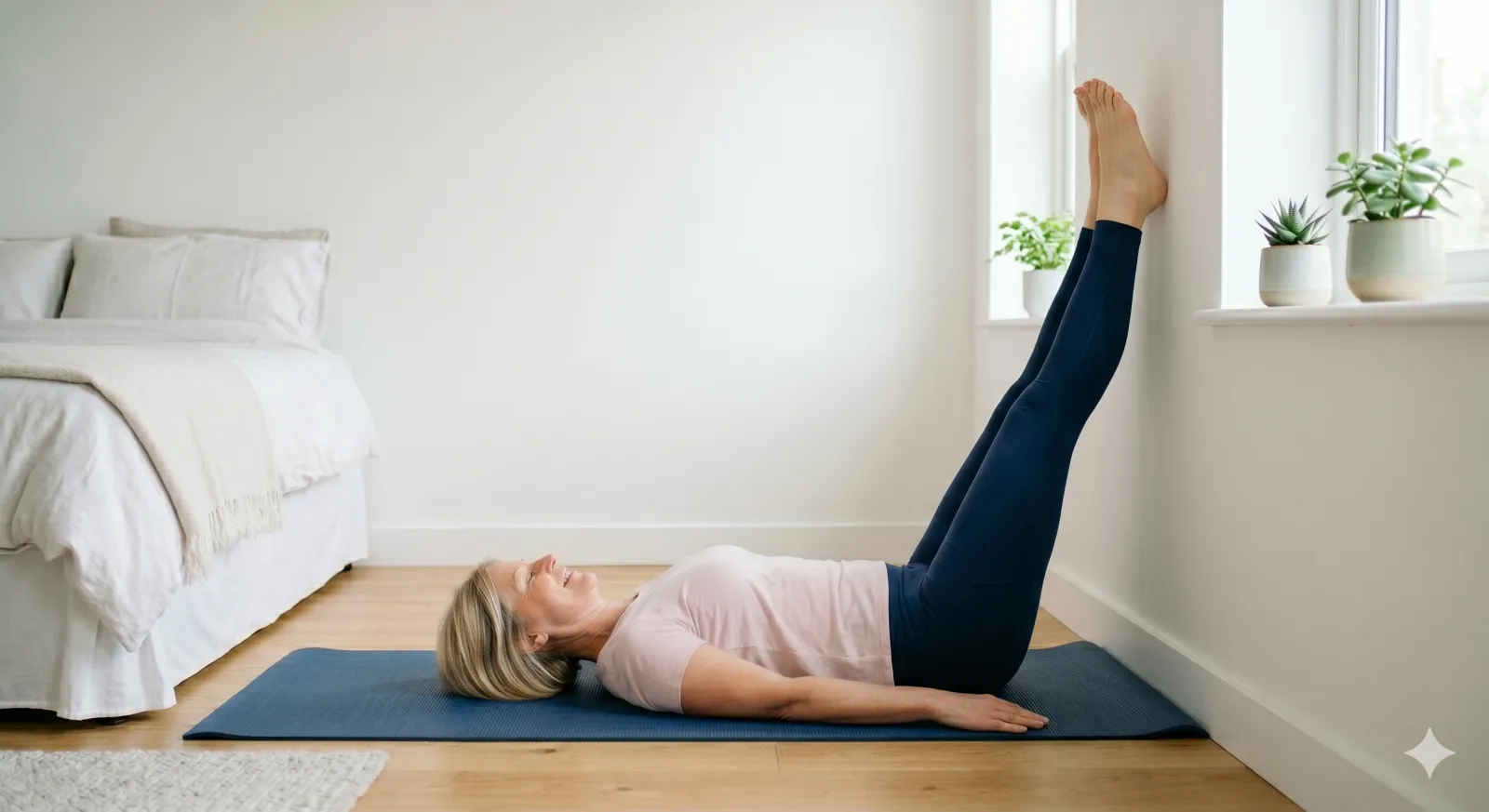
- Legs Up the Wall — L-shape position, legs resting against the wall. Hold 2 minutes — good for circulation and lower back release.
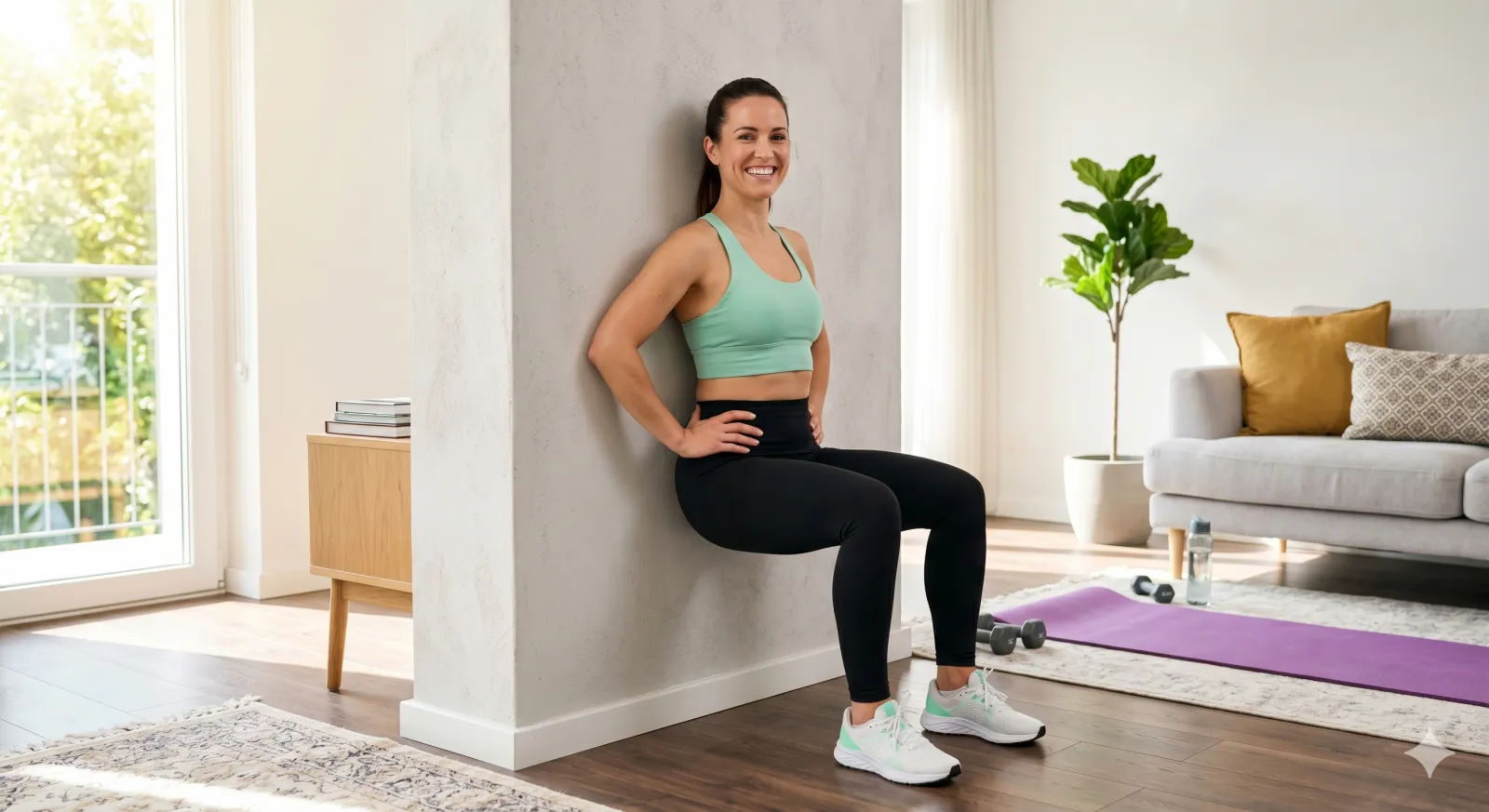
- Wall Sit — Back flat against the wall, slide down until thighs are parallel to the floor. Hold 30 seconds × 3 sets.
- Wall Push — Hands on wall at shoulder height, lean in and press back. 15 reps × 3 sets.
Week 2 (Days 8–14) — Build
Increase to 45 seconds per move, 4 sets each. Add one variation per exercise.
- Single-Leg Wall Bridge — Same as Week 1 bridge, extending one leg toward the ceiling as you lift.
- Wall Sit Hold Extended — 45 seconds, add small arm raises to challenge stability.
- Knee Twist — Feet on wall, lying on back. Slowly drop knees side to side, 10 reps each side.
- Wall Calf Raises — Stand facing the wall, hands lightly touching for balance. Rise onto toes, lower slowly. 15 reps × 4 sets.
Week 3 (Days 15–21) — Combine
Start linking two movements together — this is where you’ll feel real strength gains.
- Bridge + Leg Extension Combo — Lift into bridge, extend one leg, hold 3 seconds, lower. Alternate legs.
- Wall Sit + Arm Circles — Hold the sit position while drawing slow circles with your arms. 45 seconds.
- Wall Plank Hold — Feet elevated on wall, hands on floor in plank. Hold 20 seconds × 4 sets.
Week 4 (Days 22–28) — Complete
Full routine, 20–25 minutes. This week is where you’ll notice how far you’ve come. To continue into a 30-day challenge, repeat Week 3 and 4 moves for two extra days — by now your body is ready for it.
Before You Start
- Yoga mat ready (a folded blanket works too)
- Clear wall space: roughly 1.5m × 1.5m
- This page bookmarked on your phone
- Start date marked in your calendar
- Workout clothes set out the night before Day 1
Best YouTube Wall Pilates Workouts to Follow
What to Look for as a Beginner
Searching for wall pilates videos can be overwhelming — hundreds of options that look nearly identical in the thumbnail. Filter by length first. For beginners, 10–20 minutes is the sweet spot; anything longer and completion rates tend to drop, especially in the first couple of weeks when the habit is still fragile.
For beginners over 50 specifically, look for instructors who cue modifications in real time and explain terms like “neutral spine” rather than assuming you already know them. The video below does that well.
Pairing your sessions with something that supports recovery and sleep — like magnesium glycinate for perimenopause sleep in the evening — can make a noticeable difference in how your muscles feel the next morning.
💪 Pro Tip
During every wall bridge or core move, press your lower back flat against the floor before you begin. If your lower back lifts, your core has checked out and your lumbar spine is doing the work instead. “Belly button toward spine” is the cue that protects your back and gets more out of every move in this plan.
Follow along at home — no equipment needed beyond a wall and a mat.
Wall Pilates and Your Whole Wellness Routine
Pairing Movement With Recovery
The people who get the most out of this kind of training aren’t just doing the exercises — they’re paying attention to what happens after. Cortisol levels, sleep quality, and recovery all shape how the body responds to consistent movement.
That’s part of why pairing this with nervous system regulation techniques works well — pilates already engages the parasympathetic nervous system through breathwork and controlled movement, and a short wind-down afterward helps lock that in. Nutrition matters too: pairing a new movement routine with an easy high protein meal prep plan gives muscles what they need to actually adapt. The workout builds the structure — protein helps rebuild it.
Frequently Asked Questions
Does wall pilates really work for beginners?
Yes, for most people — the wall provides constant physical feedback that tells your body when alignment is off, which speeds up learning. Many beginners notice improved core engagement within the first week and visible posture improvements within two to three weeks of consistent practice, three to four times a week.
Does Pilates help with high cortisol?
It may help. Pilates engages the parasympathetic nervous system through slow, controlled breathing and deliberate movement, both of which work against the stress response that drives cortisol spikes. For women dealing with chronic stress or perimenopause-related hormonal shifts, this is an underappreciated benefit of a consistent practice — pairing it with dedicated nervous system regulation techniques can amplify the effect.
Can an 80-year-old do wall pilates?
Often, yes. The wall provides balance support and reduces fall risk, and movements can be scaled to almost any fitness level — even someone who hasn’t exercised in years can start with basic holds and legs-up-the-wall positions. Anyone with serious joint conditions, osteoporosis, or recent surgery should check with their doctor first.
Can wall pilates help with weight loss?
It’s not primarily a calorie-burning workout, but it can support weight management two ways: building lean muscle mass, which raises resting metabolic rate, and improving body composition over time, especially around the core. Consistency matters more than intensity — pairing it with a protein-focused diet tends to give the best results.
What are the 3 C’s of Pilates?
A common shorthand for Pilates principles is Centering, Concentration, and Control. Centering means initiating movement from the core. Concentration means full mental focus on the movement rather than going through the motions. Control means every action is deliberate rather than rushed. Wall pilates tends to enforce all three naturally, since the wall gives immediate feedback from the first session.
Not medical advice — check with your doctor before starting a new exercise routine, especially with joint conditions, osteoporosis, or after recent surgery.
Bookmark this page, set your start date, and show up tomorrow. 28 days from now, you’ll be glad you did. 🧘
You May Also Like
 7 Best Exercises for Bad Knees: Safe & Low Impact Guide
 Somatic Exercises for Weight Loss: Free 28-Day Plan
 Google Sheets Tutorial for Beginners: Formulas That Work
 Back Pain From Sitting: Why Driving and Desk Work Hurt
 7 Free Nervous System Regulation Exercises at Home
 Sciatica Keeps Coming Back? 3 Real Reasons Why
 How to Find Unclaimed Money from the Government for Free
 Government Grants for Individuals: 5 Free Programs