Not legal or financial advice — verify details with the official government source before acting, and never pay for a search you can do yourself for free.
The hardest part isn’t finding the money. It’s realizing it might already have your name on it.
Forgotten bank accounts, uncashed insurance checks, undelivered tax refunds — billions of dollars currently sit in state and federal databases waiting to be claimed. According to the National Association of Unclaimed Property Administrators (NAUPA), a notable share of Americans have unclaimed property they don’t know about.
This money doesn’t wait forever, either. IRS tax refunds must generally be claimed within 3 years of the original filing deadline — after that, the money is transferred to the U.S. Treasury and the right to claim it is lost.
Start with your name. Ten minutes later, you’ll know whether anything is waiting — where to look, how to search by state, and how to avoid the scams that circulate in this space.
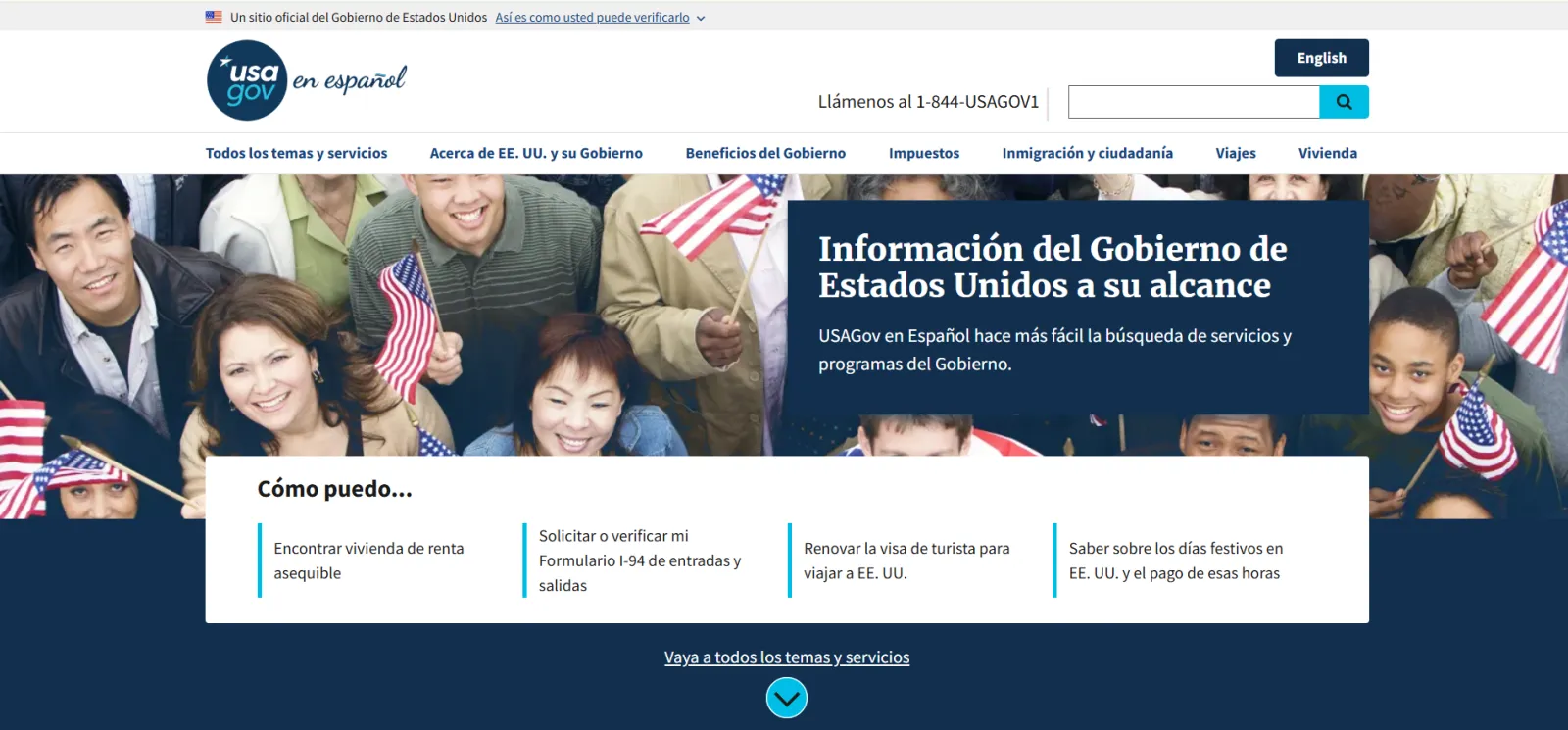
▲ The official USA.gov unclaimed money portal — free to search.
Key Takeaways
- A meaningful share of Americans have unclaimed money, per NAUPA — amounts range from small sums to thousands of dollars
- IRS tax refunds generally expire after 3 years, after which the money is gone permanently
- Legitimate search tools are free: USA.gov, MissingMoney.com, and Unclaimed.org
- Check every state ever lived in, not just the current one
- Never pay anyone to search for unclaimed money — it’s always free to do yourself
Is Unclaimed Money Real, or a Scam?
Why Billions Go Unclaimed Every Year
Fair question, given how many fake “unclaimed money” sites exist to harvest personal information. To be clear: unclaimed money is real, and it’s held by official state and federal government agencies.
Here’s how it works. When a bank, insurer, or employer can’t locate someone to deliver money that’s rightfully theirs — a forgotten savings account, an uncashed paycheck, an insurance payout — they’re generally required to transfer those funds to the relevant state government, which holds it until claimed.
NAUPA reports that states return a substantial amount in unclaimed money to rightful owners every year, and that figure keeps growing as people move, change jobs, and lose track of what they’re owed. The money doesn’t disappear — though as covered below, some categories do have real deadlines.
What types of money go unclaimed?
Dormant bank accounts, uncashed insurance checks, forgotten utility deposits, undelivered stock dividends, uncashed payroll checks, and IRS tax refunds are the most common sources. Moving without updating an address, changing jobs multiple times, or a relative passing away without you knowing about their accounts are all common ways money ends up unclaimed.
What’s the Most Common Unclaimed Money?
Tax Refunds, Stimulus Checks, and Forgotten Retirement Benefits
Some categories carry hard deadlines most people don’t know about.
IRS Unclaimed Tax Refunds — the most time-sensitive: Many people who don’t file a return assume they don’t earn enough to owe taxes, without realizing they may be owed a refund. The IRS generally holds unclaimed refunds for 3 years from the original filing deadline, after which the money is absorbed into the U.S. Treasury with no exceptions. Check refund status at irs.gov/refunds.
COVID-19 stimulus checks: Anyone who missed one or more of the stimulus rounds may still be able to claim the amount through the Recovery Rebate Credit on a federal tax return, even without normally filing taxes.
Unclaimed retirement benefits: Often the most overlooked category. Changing jobs multiple times raises the odds of an old 401(k) or pension balance sitting unclaimed. The National Registry of Unclaimed Retirement Benefits allows a free search by Social Security number to locate forgotten retirement accounts.
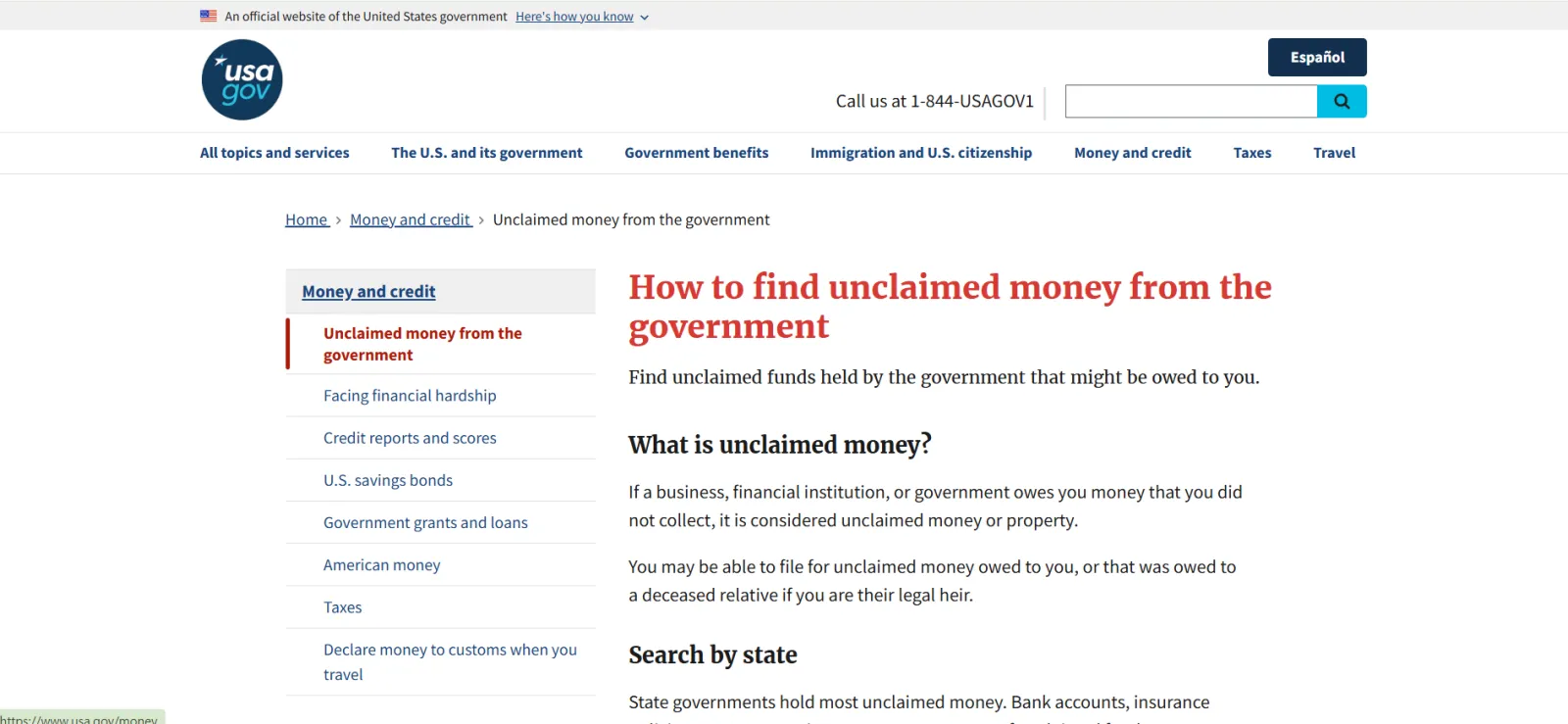
▲ MissingMoney.com searches multiple state databases at once, for free.
How to Check for Unclaimed Money
Start With MissingMoney.com and Unclaimed.org
The whole process takes under 10 minutes and costs nothing.
First — MissingMoney.com: Enter a first name, last name, and state. NAUPA-endorsed, and it searches multiple state databases at once. A match redirects to the official state agency to begin a free claim.
Second — Unclaimed.org: Some states maintain separate databases not fully covered by MissingMoney.com, so checking both gives a more complete picture. This connects directly to each state’s official unclaimed property program.
Third — USA.gov: For federal-level funds — IRS refunds, Treasury payments, VA benefits, savings bonds — USA.gov/unclaimed-money is the official portal linking to every federal agency database.
Check Every State Ever Lived In
This is the step most people skip, and where the biggest amounts get missed. Unclaimed property is held by the state where the account or policy originated, not necessarily where someone lives now.
California holds one of the largest pools of unclaimed property in the country — anyone who’s lived or worked there should check the California State Controller’s Office at ucpi.sco.ca.gov. Pennsylvania residents and former residents should check patreasury.gov/unclaimed-property.
A list of every state lived, worked, or banked in, searched individually through Unclaimed.org’s state directory, takes an extra 15 minutes but can surface money a multi-state search misses.
How do I check if I have unclaimed money from the government?
Start at MissingMoney.com for a multi-state name search, then cross-check Unclaimed.org. For federal refunds, use irs.gov/refunds. For forgotten retirement accounts, check unclaimedretirementbenefits.com. For savings bonds and Treasury payments, visit TreasuryHunt.gov. The process is free and takes under 15 minutes — no payment, ever.
Free Search Checklist
- Search MissingMoney.com with full name + current state
- Repeat for every state previously lived or worked in
- Check IRS refund status at irs.gov/refunds
- Search forgotten retirement accounts at unclaimedretirementbenefits.com
- Never pay a finder’s fee — official searches are always free
How to Avoid Unclaimed Money Scams
Never Pay for a Free Search
If anyone asks for payment to find unclaimed money, that’s a clear signal to walk away — legitimate searches through state and federal databases are always free.
An entire “finder service” industry charges upfront fees or takes a cut of recovered money — sometimes a significant percentage. These aren’t illegal in most states, but they’re unnecessary since the same search can be done for free in minutes.
Red Flags to Watch For
Emails claiming money has already been found in your name, websites that look official but use non-.gov domains, and any service requesting payment before showing results. Legitimate government sites don’t cold-email about unclaimed funds — search official databases directly first.
💰 Pro Tip
If multiple states have been home over the years, search each individually rather than relying only on MissingMoney.com. California, Texas, New York, and Pennsylvania each maintain separate databases that don’t always sync with the multi-state search.
A look at how to find and claim unclaimed property for free.
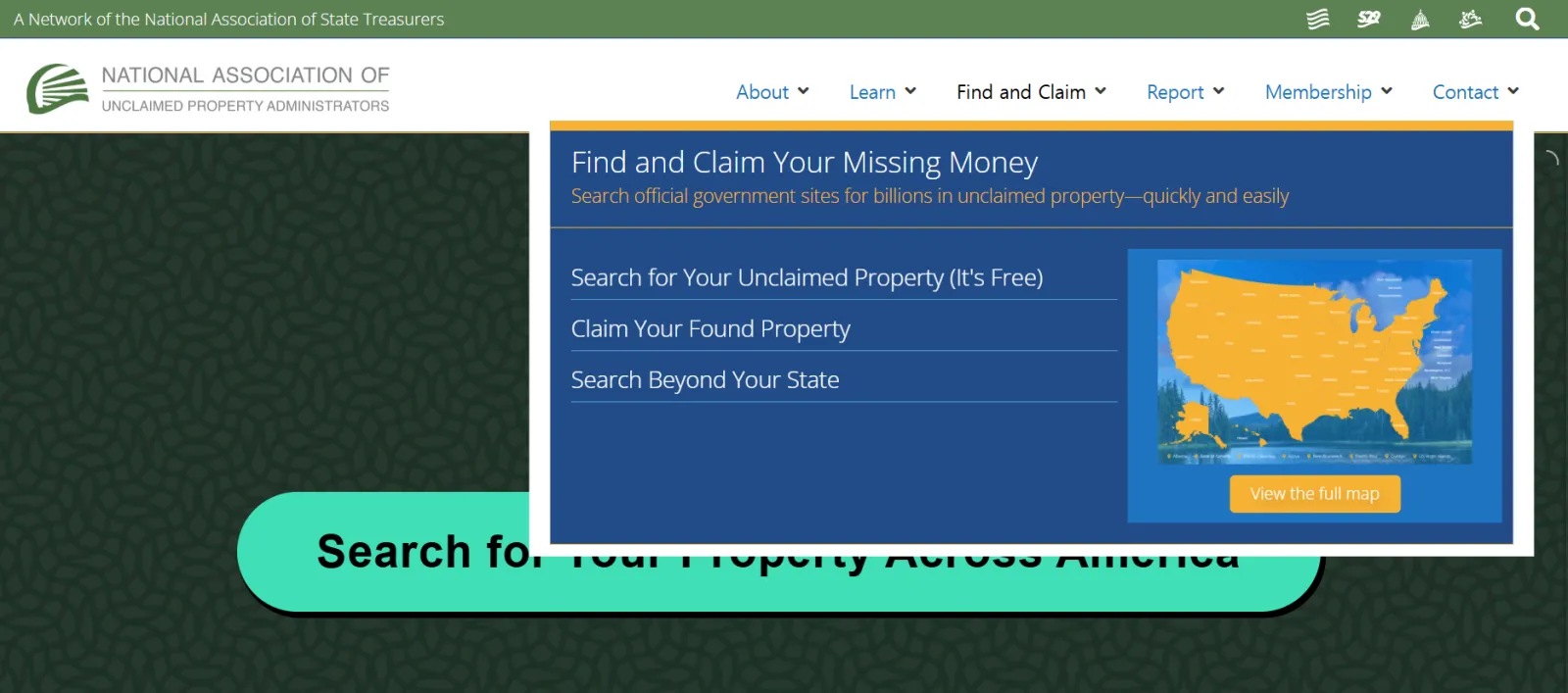
▲ Unclaimed.org, NAUPA’s official state-by-state search tool.
What Happens After You Find a Match?
Filing a Claim
Finding a name match is just the first step. The search site redirects to the official state unclaimed property office to begin a claim — free, but requiring identity verification.
Typically needed: a government-issued photo ID, Social Security number proof, and documentation linking to the original account or address (an old utility bill or bank statement works). Processing times vary by state, generally 30 to 90 days, with some states issuing direct deposit and others a check.
One note: some unclaimed money, particularly interest earned, may be taxable. For significant amounts, a tax professional can clarify the implications. Once funds are recovered, pairing that with a solid meal prep on a budget strategy or learning how to freeze rows in Excel for tracking finances are practical next steps.
Frequently Asked Questions
How do I check if I have unclaimed money from the government?
Start with MissingMoney.com for a free multi-state search by name, then check Unclaimed.org for states not covered. For IRS refunds, use irs.gov/refunds. For forgotten retirement accounts, visit unclaimedretirementbenefits.com. For federal savings bonds, check TreasuryHunt.gov. The process is free and takes under 15 minutes. Never pay anyone to do this search.
What’s the easiest way to find unclaimed money?
MissingMoney.com is the easiest starting point — enter a name and state, and it searches multiple state databases at once for free. It’s NAUPA-endorsed and takes about two minutes. A match links directly to the official state office to file a free claim.
What’s the most common unclaimed money?
Dormant bank accounts, uncashed insurance checks, forgotten utility deposits, unclaimed stock dividends, and IRS tax refunds. Forgotten 401(k) balances are increasingly common for people who’ve changed jobs multiple times.
How do I check for unclaimed stimulus money?
Anyone who missed one or more COVID-19 stimulus payments may be able to claim the missing amount through the Recovery Rebate Credit by filing a federal tax return for the relevant year. The IRS doesn’t automatically send unclaimed stimulus money — filing is required. Visit irs.gov/eip for current guidance.
Is it safe to search using a Social Security number?
For the initial search, an SSN generally isn’t required — a name and state search on MissingMoney.com or Unclaimed.org is enough to find matches. An SSN is typically only needed during the official claims process, and should only be entered on official .gov sites or verified nonprofit databases like unclaimedretirementbenefits.com — never on a site reached through an unsolicited email or social media ad.
Not legal or financial advice — verify details with the official government source before acting, and never pay for a search you can do yourself for free.
Open MissingMoney.com and type your name. It takes two minutes, and there might be a check out there with it on. 💵
You May Also Like
 Government Grants for Individuals: 5 Free Programs
 LIHEAP: Income Guidelines, Eligibility, and How to Apply
 How to Apply for SNAP Food Stamps Online and Get Approved Fast
 Korea Convenience Store Guide: CU & GS25 Tips for Tourists
 Somatic Exercises for Weight Loss: Free 28-Day Plan
 Korea Subway Transfer System: 7 Rules Every Visitor Must Know
 WOWPASS Card Korea: 5 Reasons to Get It on Day 1
 Dental Implant Cost Without Insurance: The Number Your Dentist Won’t Show You First