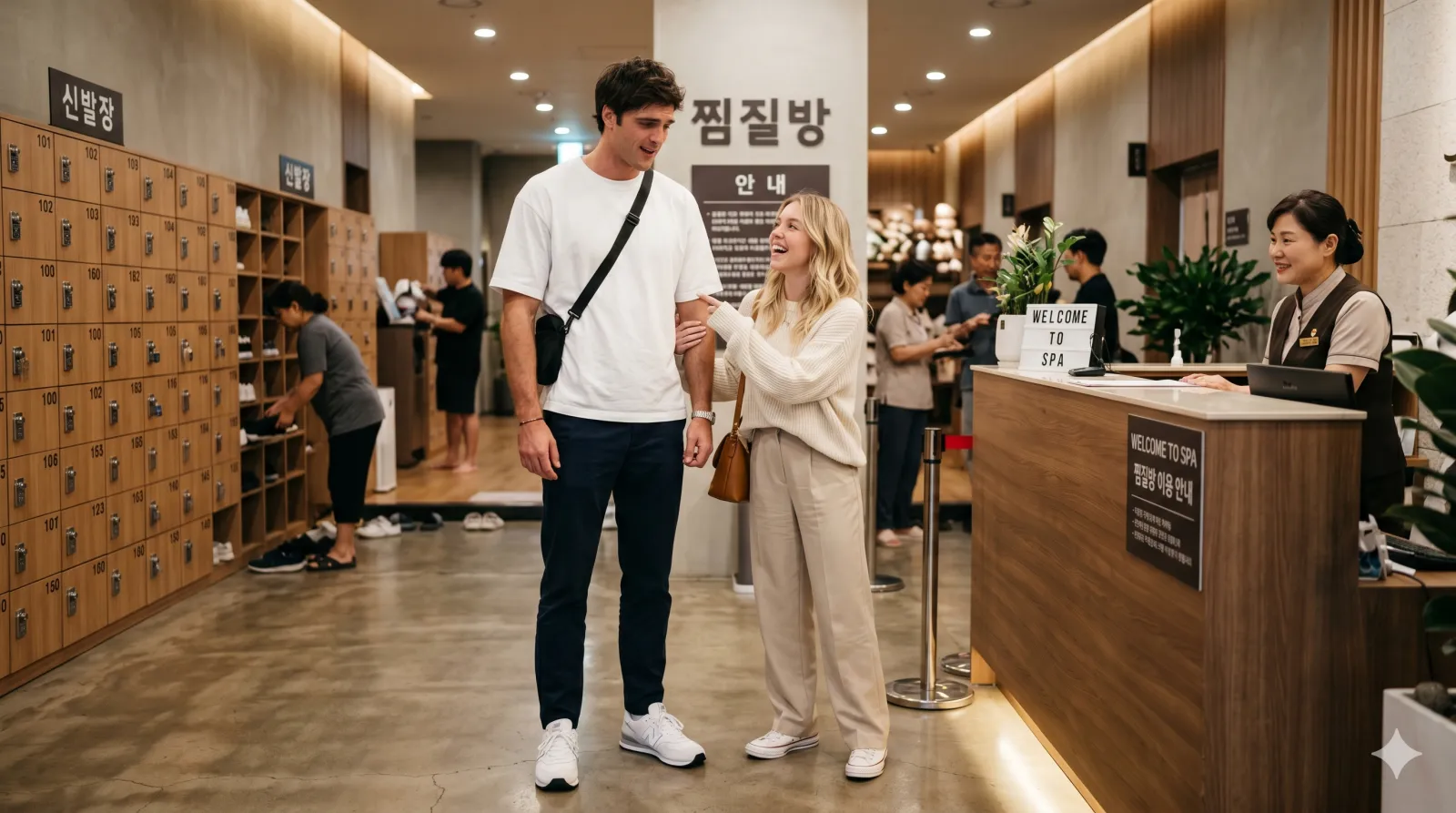
A jjimjilbang is split into two zones — only one requires you to be naked, and both are worth experiencing.
Let’s address the elephant in the room: yes, you have to be fully naked — at least in one part of the building. But before you let that cancel your Seoul plans, keep reading.
A jjimjilbang (찜질방) is one of the most unique experiences you can have on any Korea travel itinerary, and arguably one of the most underrated things to do in Seoul. For many Koreans, it’s part of everyday life rather than a special occasion. It’s not just a spa. It’s a 24-hour cultural universe packed with saunas, sleeping rooms, snack bars, and yes — the iconic sheep head towel.
Walk in like you’ve done it a hundred times. Every rule, every ritual, every unwritten etiquette point — covered below.
What Is a Jjimjilbang, Exactly?
Here’s the thing most people get wrong before their first visit — they picture one big naked room, and that terrifies them before they even arrive. The truth is, a jjimjilbang is split into two completely separate zones, and only one of them requires you to take your clothes off. Once you understand this split, the whole experience becomes a lot less intimidating.
The Naked Zone (Gender-Segregated) vs. The Clothed Zone (Co-ed)
The naked zone is the bathhouse area — hot tubs, cold pools, showers, and steam rooms. This section is completely gender-segregated, meaning men and women each have their own private area. Nobody from the opposite sex will see you here. Ever.
The clothed zone is the main communal area where everyone hangs out together — men, women, families, couples, all in the same space. Here you wear the uniform provided at check-in, usually an orange or pink short-sleeve T-shirt and matching shorts. This is where you eat, sleep, sweat in themed saunas, and fold that famous sheep head towel. No swimsuits, no personal clothes — just the uniform. This is the single most important thing to know before you go.
🧖 Pro Tip — Don’t Lose Your Keyband
Your electronic locker key is tied to your shoe locker number. Every snack you buy, every extra service you add — it all gets charged to this band. When you leave, you must pay your tab at the front desk or a kiosk. If you don’t settle the bill first, your shoe locker will literally not open. Keep it on your wrist the entire time.
Your First Seoul Jjimjilbang Visit, Step by Step
Nobody tells you this, but the first five minutes are the most confusing. You walk in, there are shoe lockers everywhere, staff behind a counter, Korean signs you can’t read, and you’re not sure where to go. Here’s the breakdown so you never have to guess.
The Magic Keyband System
Remove your shoes at the entrance and place them in one of the numbered shoe lockers near the door. Take the small key. Then head to the front desk and pay the admission fee — most jjimjilbangs in Seoul charge between 10,000 and 15,000 KRW, though it varies a lot by location. A few real examples:
- Dragon Hill Spa (Yongsan) — 14,000 KRW weekday / 16,000 KRW weekend, open 24 hours. One of Seoul’s largest, with clay and charcoal rooms plus an outdoor hot spring pool and swimming pool.
- Sparex (Dongdaemun, Good Morning City B3) — pricing shifts between day and night rates. Hanok-themed interior, with arched kiln saunas split into medium and high heat. Popular with foreign visitors.
- Tentendai (Konkuk, inside Star City Mall) — open 10:00 AM to 5:00 AM, not 24 hours. Japanese-style sauna concept with a hinoki (cypress) tub and foot bath.
Prices and hours shift over time at any individual location, so it’s worth a quick search for current rates before you go.
At check-in, staff will hand you a keyband and a uniform set. The keyband is your all-in-one tool — it opens your locker, pays for your food, and covers any extra services like a body scrub. Your shoe locker number matches your clothes locker number, so it’s all connected. Head to the gender-separated changing area, store everything in your locker, and you’re ready to go.
One more thing worth knowing before you go: most are open 24 hours, and overnight stays are completely normal. Admission alone runs about 15,000 to 20,000 KRW for a full night. Meals are always separate, though — whether it’s ramen or a boiled egg, you’re paying for it at the snack counter as you go, so budget a little extra for food. It’s one of the best-kept secrets for budget travelers in Korea.
💡 Stay Longer, Pay More
Some locations add a surcharge of about 1,000 KRW per hour once you pass the 12-hour mark. If you’re planning a long stay, it’s worth checking ahead.
Skip the Hostel: Sleeping at a Jjimjilbang
If you’re planning Seoul travel on a budget, this is the trick locals already know. A hostel dorm bed in Seoul typically runs 30,000 to 40,000 KRW — a jjimjilbang gets you through the night for less than half that. It’s not just cheap, it’s practical: you can shower, stash your bags, and never worry about check-in hours since the doors never close.
The savings multiply if you’re traveling with friends or family. A hotel room for four people in Seoul easily runs 100,000 to 200,000 KRW, but jjimjilbang pricing is per person — four people can usually get through the night for 50,000 to 60,000 KRW combined. Nobody has to share a cramped room either; the lounge floor is wide open, so everyone finds their own spot and regroups in the morning.
This is especially useful when:
- You missed the last subway or bus
- You’ve got an early flight and just need a few hours near the airport
- You’ve checked out of your hotel but your flight isn’t until late
- You want to stretch the travel budget by skipping one night’s hotel cost
- You’re traveling as a group and want to cut down on lodging costs together
Even if you didn’t plan for it, knowing a jjimjilbang is always an option means an unexpected extra night in Seoul is never a real problem.
Check Today’s USD to KRW Rate
Convert dollars to won before you budget your jjimjilbang trip.
| Step | Where | What to do |
|---|---|---|
| 1. Shoes | Entrance | Store shoes in a locker, take the key, pay admission at the counter |
| 2. Changing | Gender-separated zone | Strip fully for the wet baths, or put on the provided uniform |
| 3. Wet bath | Gender-separated zone | Shower with soap before entering any hot tub — mandatory |
| 4. Lounge | Co-ed zone | Wear the uniform, order sikhye and eggs, enjoy the saunas |
Korean Bathhouse Etiquette: The Wet Zone Rules
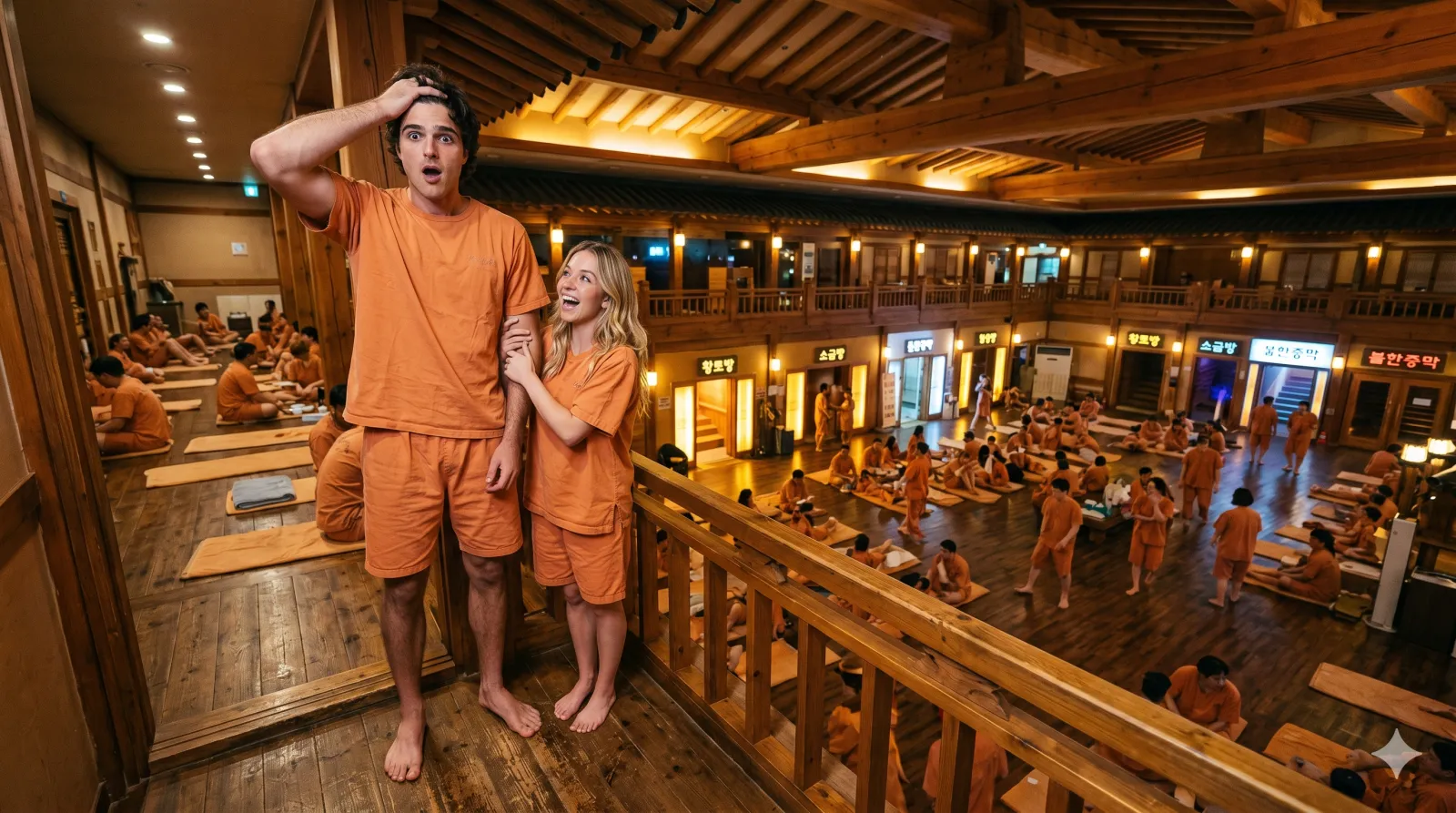
The communal area is where the real experience happens — matching uniforms, heated floors, and total relaxation.
The gender-segregated bathhouse section is where most first-timers feel the most nervous. The golden rule is simple: shower with soap before you get into any of the communal tubs. This is not optional — it’s the most basic piece of korean bathhouse etiquette, and Korean regulars will notice if you skip it. Take your time in the shower, then work your way through the tubs from warm to hot.
Shower Before You Soak — and What Seshin Actually Is
Once you’re in the hot tubs, you’ll notice some visitors lying on flat tables getting what looks like an aggressive rubdown. That’s seshin (세신) — the traditional Korean body scrub. A professional scrubber uses a coarse Italian towel to remove layers of dead skin, and watching what actually comes off your own skin is genuinely shocking. It costs around 25,000 to 30,000 KRW, charged to your keyband, takes 45 minutes to an hour, and yes, it does hurt a little — say “cheon-cheon-hi” (천천히, “slowly”) if you want them to ease up.
We go deep on seshin — what to expect, how to prepare, and whether it’s worth it — in a separate guide, since it deserves more than a paragraph here.
Not Just One Korean Sauna: Themed Heat Rooms
Bigger jjimjilbangs rarely stop at a single Korean sauna. Walk the halls and you’ll find a row of dome-shaped kiln rooms, each with its own mineral and temperature — charcoal, clay, and salt are the most common. There’s usually an ice room too, sitting around -5°C, meant for quick dips between the hot rooms rather than long stays. Pick whichever door doesn’t have a line and lie down; most people rotate through two or three over a visit.

Guests relaxing on the heated ondol floor in the communal lounge

Three themed kiln sauna rooms, each with its own heat and mineral

Inside the salt kiln sauna — heated salt therapy for guests
The Communal Lounge: Sheep Towels, Sikhye, and Baked Eggs
The first time you walk into the communal area of a large jjimjilbang, you’ll stand there for a full minute just taking it in. Dozens of people in matching orange uniforms spread across a massive wooden floor, some sleeping, some eating, some watching TV. Change into your uniform, find a spot on the floor, and you’ll settle in within minutes.
Folding the Sheep Head Towel and Eating Baked Eggs
There are two things you absolutely must do in the communal area. First: the sheep head towel, called yangmeori (양머리). Take a white cotton towel, roll both long edges tightly toward the center to form a thick tube, then place it across the top of your head and bend both ends upward into two firm horn shapes. It looks ridiculous on everyone, which is exactly the point.
Second: the snacks. Order sikhye (식혜) — a cold, lightly sweet rice punch with floating rice grains — and a few baked eggs (맥반석 계란). The eggs have darkened brown shells and a slightly smoky flavor from being cooked in mineral stone heat. Sikhye runs about 4,000 KRW and eggs around 3,000 KRW for three. Sit cross-legged on the wooden floor, towel horns on your head, eggs in hand. This is the jjimjilbang experience in its purest form.
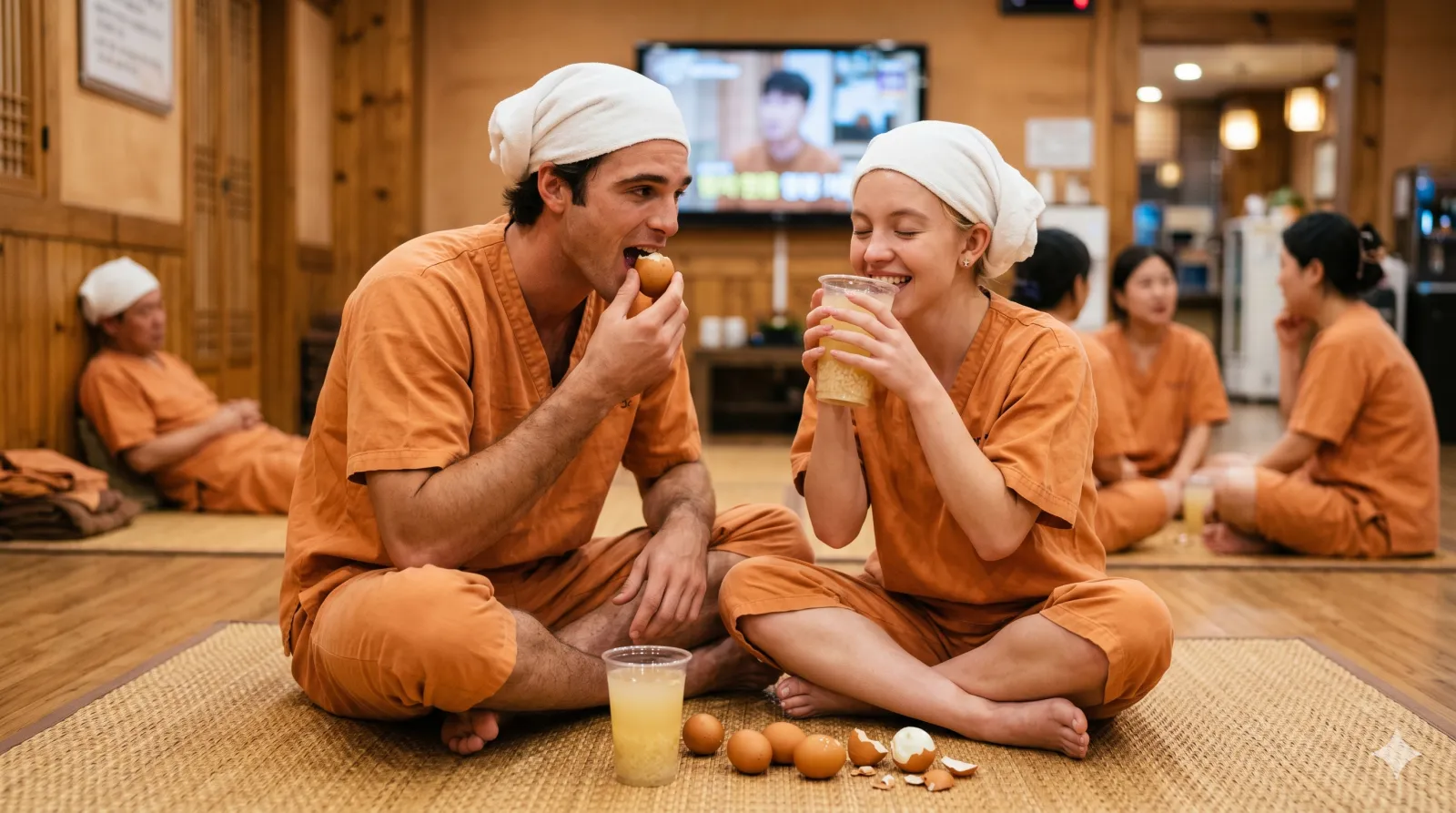
Sikhye and baked eggs are the two iconic jjimjilbang snacks — order both on your first visit.
First-timers experience a Korean jjimjilbang — exactly what to expect on your visit.
Rules You Can’t Ignore: Camera Etiquette and Common Mistakes
Most foreigners who have a bad experience made one of a few avoidable mistakes. The rules below aren’t complicated, but they matter. Koreans take communal spaces seriously, and respecting the environment is what keeps the whole thing running smoothly for everyone.
No-Camera Zones and What About Tattoos?
Photography is completely banned in the changing rooms and bathhouse areas — this is a legal issue in Korea, not just a house rule. Even pulling out your phone in those zones can cause serious problems.
The communal lounge isn’t automatically fair game either. Everyone’s carrying a phone these days, so it’s easy to snap a casual photo without thinking — and if a stranger ends up in the frame, it can come across as sneaking a shot of someone. Keep the frame tight on your own group, and if people around you are sleeping or relaxing, just put the camera away.
As for tattoos — these days it’s really not a big deal in Korea. Unlike Japan’s strict onsen bans, it’s rare to hear of anyone turned away over ink, whether at a large foreigner-friendly spot like Dragon Hill Spa or a regular neighborhood jjimjilbang. If you’re still unsure, a quick call ahead is more than enough peace of mind.
🧴 A Few Small Things to Know
Some hair dryers are coin-operated, and plenty of jjimjilbangs only provide soap — no shampoo or conditioner. Convenience stores and the jjimjilbang’s own counter both sell single-use toiletry sets if you didn’t bring your own. Phone theft happens occasionally too, so keep valuables secured to your keyband.
Frequently Asked Questions
What are the rules for a jjimjilbang in Korea?
Shower with soap before entering any communal tub, no swimsuits or personal clothing in the bathhouse area, no photography in changing rooms or bathhouse sections (this is illegal in Korea), be mindful about catching strangers in lounge photos, keep noise levels low in rest areas, and always settle your keyband tab before leaving or your shoe locker will not open.
How much does a jjimjilbang cost in Seoul?
Most jjimjilbangs charge 10,000 to 15,000 KRW for admission — Dragon Hill Spa runs 14,000 KRW weekday/16,000 KRW weekend, Tentendai is 13,000 KRW. Add snacks like sikhye and baked eggs (roughly 3,000–4,000 KRW each) and an optional seshin body scrub (25,000–30,000 KRW), and a full visit including an overnight stay usually lands around 15,000 to 20,000 KRW all-in — still cheaper than a guesthouse bed. Some locations add a 1,000 KRW/hour surcharge past the 12-hour mark.
What should I bring to a jjimjilbang?
Almost nothing — that’s the beauty of it. Towels, shampoo, body wash, and a uniform are all provided or available to purchase on-site. Just bring a form of payment, a change of clean underwear, and optionally earplugs if you’re planning to sleep overnight. Leave the jewelry at home — metal heats up fast in saunas.
Is it okay to sleep overnight at a jjimjilbang?
Completely normal and very common. Most jjimjilbangs have dedicated sleeping areas with thin mats on the heated ondol floor. The overnight rate is usually just the admission fee, making it far cheaper than a Seoul hostel dorm bed (typically 30,000–40,000 KRW). Splitting the cost with friends or family makes it even cheaper than a hotel room — useful if you’ve missed the last train or have an early flight.
Can you wear clothes in a Korean sauna?
In the communal jjimjilbang zone, yes — you wear the provided uniform at all times. In the gender-separated bathhouse and wet areas, no personal clothing is permitted. No swimsuits, no shorts, nothing. This applies to everyone, Korean and foreign visitors alike.
What do you eat at a jjimjilbang?
The two iconic snacks are sikhye (식혜), a cold sweet rice punch for around 4,000 KRW, and baked eggs (맥반석 계란) cooked in mineral stone heat for around 3,000 KRW per three eggs. Larger jjimjilbangs also have full food courts — kalguksu (noodle soup) and miyeokguk (seaweed soup) are especially popular there, alongside ramen, bibimbap, and samgyetang.
Push through the first five minutes of awkwardness — by the time you’re sitting on that warm wooden floor, eggs in hand and a sheep towel on your head, you’ll understand why locals rank it among the best things to do in Seoul. Whatever else is on your Korea travel list, this belongs on it. 🇰🇷
You May Also Like
 South Korea Travel Budget: One Month in Korea for $1,000
 How to Eat Korean BBQ in Seoul
 Things to Do in Seoul: 15 Proven Picks Every First-Timer Needs
 Free Seoul Metro Map & Tourist Maps: Official Downloads
 Apartment in Seoul: 5 Best Options for Foreigners
 Olive Young Korea: 10 Best Korean Skincare Must-Haves
 Seoul Subway Map & Transfer Guide: 7 Rules for Seoul Travel
 Gwangjang Market Seoul: Street Food & Opening Hours
 Seoul to Jeju: Flights, Travel Time & Airport Guide
 5 Best Areas to Stay in Seoul Near the Subway