Korea Travel Guide
Last updated: August 18, 2026
Researched and reviewed by the Factly9 Korea travel editorial team.

Seoul Subway Map and Transfer Guide
I live in Seoul, and I find the subway the easiest way to get around the city. I use several subway lines during my regular commute. Depending on where I start, I can reach most parts of Seoul within an hour. Many central areas are about 30 minutes away.
I have also lived in cities outside Korea with only a few subway lines. Seoul has Lines 1 through 9, the Airport Railroad, and other lines that connect the city with the wider capital region. You can reach most major attractions by subway, including Gyeongbokgung Palace, Myeongdong, Dongdaemun, Seongsu-dong, and Gangnam.
Once you understand the Seoul subway map, traveling around the city becomes much easier. You can visit Gyeongbokgung Palace in the morning, have tea in Seongsu-dong in the afternoon, and watch the sunset by the Han River in the evening. You will spend less money on taxis and less time trying to find your way.
The map can look complicated at first. Each line has its own color, and the map shows hundreds of stations and many transfer points. Focus on three things: the line color, the station number, and the train direction. Stations and trains also provide key announcements in English, Japanese, and Chinese.
This guide includes an English Seoul subway map that you can save on your phone. It also explains how to use T-money, transfer between buses and subways, understand the base fare and early-morning discount, and choose the correct AREX train.
English Seoul Subway Map

Download the English Seoul subway map →
The large JPG file opens in a new tab. On a phone, press and hold the image to save it. You can then check the map even when you do not have an internet connection.
Official source: Seoul Metro Cyber Station
Need a Route Instead of a Full Map?
Select your starting station and destination in Seoul Metro Cyber Station. It will show the travel time and transfer route.
Google Maps is familiar to many international travelers and can also show subway routes. If a place does not appear or you need more detailed local transit information, try Naver Map or Seoul Metro Cyber Station.
Read the Factly9 English guide to Naver Map →
Check Three Things: Color, Number, and Direction
First, check the line color. Line 2 is green and circles many popular parts of Seoul. Line 4 is blue and passes Seoul Station, Myeongdong, and Dongdaemun. The Airport Railroad, also called AREX, connects Incheon International Airport with central Seoul.
Next, check the station number. Myeongdong Station is 424. The first digit, 4, means that the station is on Line 4. The other two digits identify the station.
A place where two or more line colors meet is a transfer station. Check the line color, station number, and train direction before you move to the platform.
Seven Rules for Using the Seoul Subway
1. Check the Platform Sign Before You Board
Stop for three seconds and check the platform sign before you get on the train.
The sign shows the line color and number, the direction of travel, the next station, and major stops.
Some subway lines split into different routes. Trains leaving from the same platform can have different final stops. Check the destination on the train or platform display before boarding. This quick check can save you from traveling in the wrong direction.
2. Choose the Right Transportation Card

A rechargeable transportation card makes it much easier to use buses and subways in Seoul.
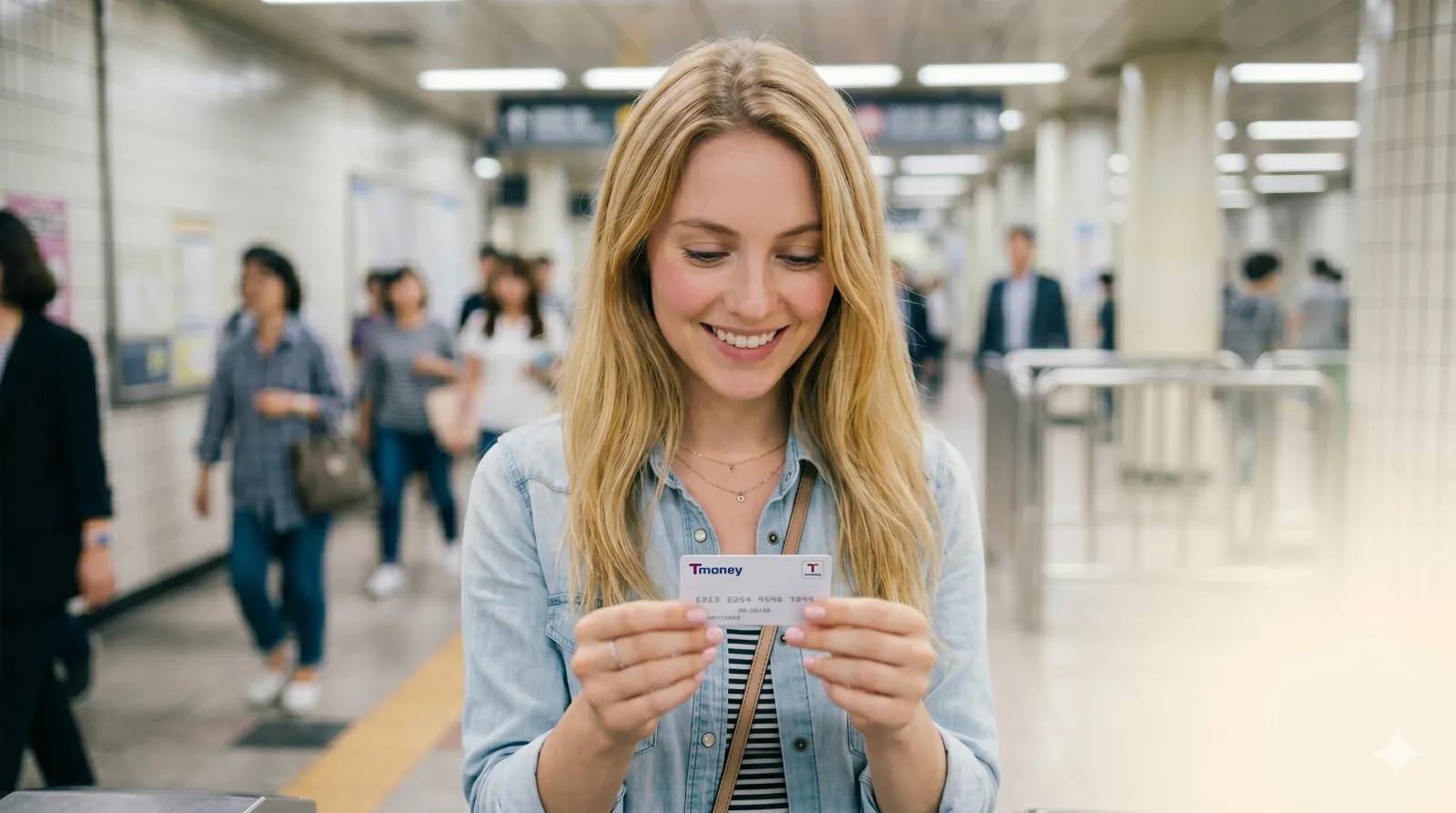
T-money is the best-known option, but other transportation cards work in a similar way. Tap the card when you start your trip instead of buying a ticket for every ride. If you follow the transfer rules, the system also applies a transfer discount between buses and subways.
You can buy a T-money card at convenience stores and customer service centers inside subway stations. Most subway charging machines have an English menu.
The price of the card does not include transportation credit. You must add money to the card before using it.
| Card | Best for | What to know |
|---|---|---|
| T-money | Most travelers who use buses and subways in Korea | Easy to buy and recharge. Transfer discounts apply when you follow the rules. |
| WOWPASS | International travelers who also want payment and currency-exchange features | The shopping balance and transportation balance are managed separately. |
Not sure which card fits your trip? Read the Factly9 T-money and WOWPASS guide.
3. Tap Your Card When You Enter and Leave
Tap your card at the subway gate when you enter. Tap it again when you leave at your destination.
On a bus, tap the reader next to the driver when you board. Before you get off, tap the reader beside the rear door.
It is easy to forget the second tap on a bus. You might be checking the stop or carrying shopping bags as you walk toward the door.
Without an exit record, the system cannot treat your next ride as a transfer. If you do not tap before leaving the bus, you lose the transfer discount.
Local tip: Take out your transportation card before the bus reaches your stop. Seoul buses do not wait long, and the exit reader is next to the rear door.
4. The Standard Transfer Time Is 30 Minutes
After tapping out, board the next bus or subway within 30 minutes. This rule applies when changing from a bus to the subway, from the subway to a bus, or from one bus to another.
From 9:00 p.m. to 7:00 a.m. the next day, the transfer time increases to 60 minutes. This is not a discount on the night fare. It only gives you more time to complete the transfer.
The clock starts when you tap out at a subway gate or bus reader. It does not start when you leave the station building or find the next platform.
You have enough time to walk to a connecting line. However, if you spend too long at a cafe between rides, the transfer period ends and you pay a new base fare.
5. You Can Transfer Up to Four Times
Seoul’s integrated transfer system allows up to four transfers during one connected journey. This means you can board up to five buses or trains, including your first ride.
I often take a bus to the subway station and continue my trip by train. Depending on my destination, I sometimes take another bus after leaving the subway. When I use the same transportation card and transfer within the time limit, the system treats these rides as one connected trip.
For example, you can take a neighborhood bus to a subway station, ride the subway, and then take another bus near your destination.
A transfer does not make the rest of the trip free. Seoul uses a distance-based fare system. Longer trips cost more.
Think of the system as one connected journey. It calculates the total distance instead of treating every bus or subway ride as a separate free trip.
6. Stay Inside the Paid Area During a Subway Transfer
If you leave a bus and board another bus with the same route number, the system treats it as a new ride. It does not count as a transfer.
If you pass through the final subway exit gate and enter the station again, the system can also charge you for a new ride.
When changing between subway lines, stay inside the paid area. Follow the signs that show the color and number of your next line.
Some transfer paths are long. This does not always mean you are going the wrong way. At large stations, the platforms for two lines can be far apart.
7. Know the Difference Between the AREX Express and All-Stop Train
The Seoul subway map also shows the Airport Railroad, or AREX. The Express Train and All-Stop Train have different stops and ticket rules.
I have taken the AREX Express from Incheon Airport to Seoul Station. Unlike the All-Stop Train, the Express requires a separate ticket. You cannot simply tap your T-money card at the gate.
- AREX Express: This train travels between Seoul Station and Incheon Airport without stopping at other stations. You cannot use T-money or a postpaid transportation card. Buy a separate QR ticket or train ticket. The regular fare is KRW 13,000 (about US$9.29).
- All-Stop Train: This train stops at every station between Seoul Station and Incheon Airport. You can use T-money and other accepted transportation cards. Tap your card when you enter and leave, just as you do on the subway.
KTX, ITX, and intercity trains are not part of Seoul’s subway transfer system.
Before traveling to the airport or taking a day trip outside Seoul, check the train type, ticket, and route. One minute of checking can prevent ticket problems later.
Seoul Subway Base Fare and Early-Morning Discount
The adult base fare with a transportation card is KRW 1,550 (about US$1.11). Extra charges apply when you travel beyond the base distance.
If your first ride begins before 6:30 a.m., you receive a 20% early-morning discount. The discounted base fare is KRW 1,240 (about US$0.89). The system uses the time of your first tap to decide whether the discount applies.
An adult single-use subway ticket costs KRW 1,650 (about US$1.18), plus a KRW 500 deposit (about US$0.36). After you arrive, insert the ticket into a deposit refund machine at the station. The machine returns the KRW 500 deposit.
For most travelers, a transportation card is more convenient than a single-use ticket. You also need to keep using the same card to receive transfer discounts between buses and subways.
Exchange-rate note: The US dollar amounts in this guide use an approximate rate of US$1 to KRW 1,400. The actual amount changes with the exchange rate.
Base fares and distance charges can change. Check the official Seoul transportation guide before your trip.
Quick Checklist Before Traveling Around Seoul
- Save the English Seoul subway map on your phone.
- Search for your destination and route in Google Maps.
- Use Naver Map or an official route service when you need more local detail.
- Check the line color, station number, and train direction.
- Make sure your transportation card has enough money.
- Tap your card when you enter and leave a bus or subway.
- Transfer within 30 minutes after tapping out. From 9:00 p.m. to 7:00 a.m., you have 60 minutes.
- Check for the early-morning discount if your first ride begins before 6:30 a.m.
- When using AREX, check whether you are taking the Express or All-Stop Train.
Official Sources
- Seoul Metro Cyber Station
- Seoul Metropolitan Government Transportation Guide
- Korea Tourism Organization Transportation Card Guide
Factly9 provides practical Korea travel information based on firsthand local experience and official sources.
You May Also Like
 Free Seoul Metro Map & Tourist Maps: Official Downloads
 T-Money Card vs WOWPASS: Which Is Better for Seoul Travel?
 5 Best Areas to Stay in Seoul Near the Subway
 Everything You Need to Know About Han River Seoul: Parks, Ramen & Night Views
 Naver Maps English: 7 Tips to Navigate Korea Like a Local
 South Korea Travel Budget: One Month in Korea for $1,000
 Seoul to Jeju: Flights, Travel Time & Airport Guide
 Apartment in Seoul: 5 Best Options for Foreigners
 Korea eSIM at Incheon Airport: Seoul Travel Guide
 Gwangjang Market Seoul: Street Food & Opening Hours