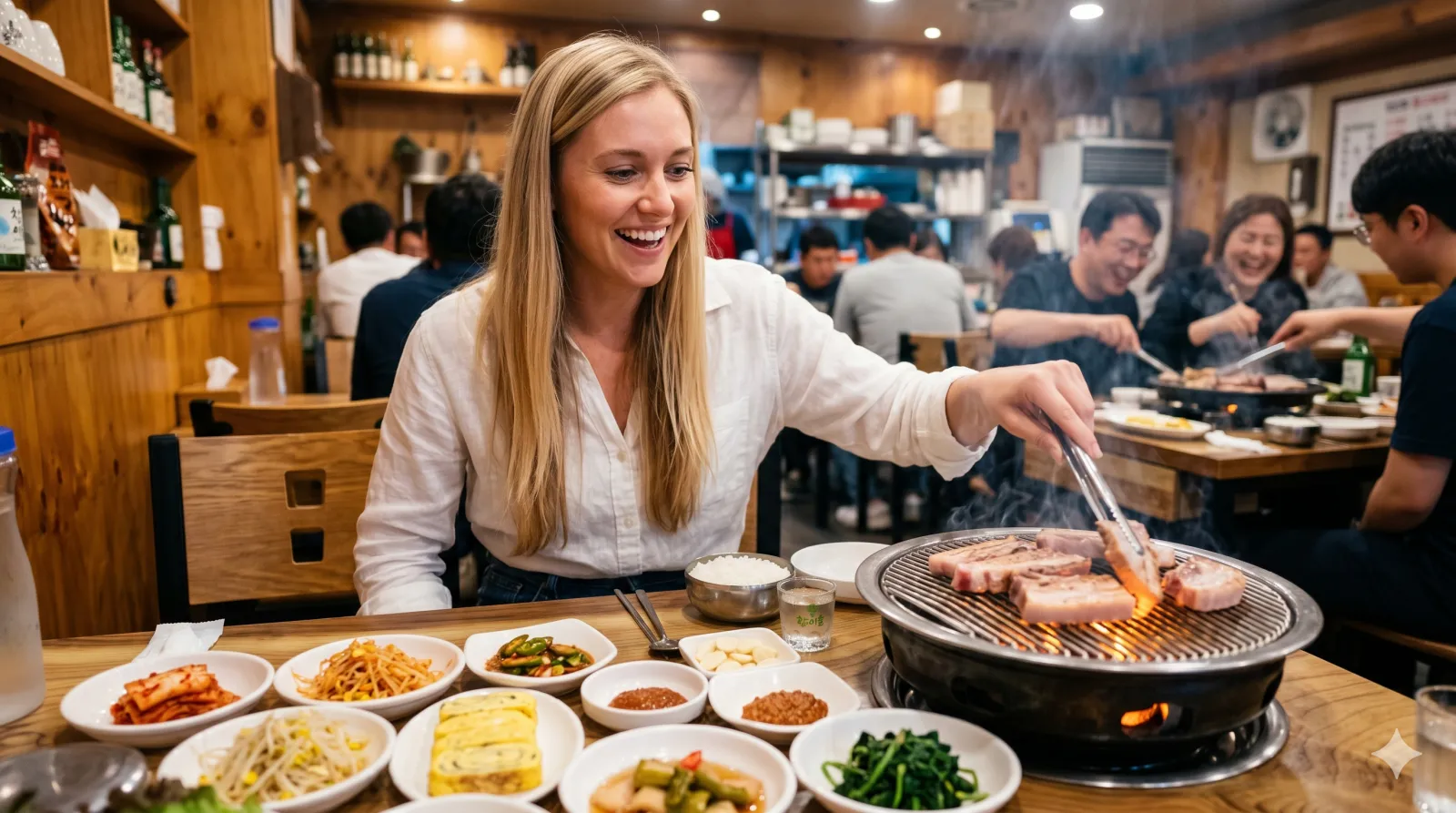
A Korean BBQ table can look complicated at first, but the basic rhythm is simple: order, grill, cut, wrap, and eat.
A Korean BBQ table can look like a small production the first time you sit down. A grill sits in the middle, tongs and scissors wait beside it, and small dishes start landing before you’ve even ordered.
Learning how to eat Korean BBQ takes about one meal to figure out.
Order the meat, grill it, cut it into bite-sized pieces, and eat it plain or wrapped in lettuce or perilla leaves with ssamjang and garlic. A few ordering habits and some basic Korean BBQ etiquette are really all that stand between you and a relaxed meal.
For a first trip built around Seoul Korean BBQ, knowing how to eat the meal matters as much as picking the restaurant. This guide covers ordering, Korean BBQ prices, meat cuts, ssam, banchan, grilling etiquette, solo dining, drinks, and tipping.
Key Takeaways
- Minimum meat orders vary by restaurant.
- Samgyeopsal and moksal are easy choices for first-time visitors.
- Some restaurants grill the meat for you, while others expect you to cook it yourself.
- Kitchen scissors are a normal tool at Korean BBQ restaurants.
- Ssam combines grilled meat with lettuce or perilla leaves, ssamjang, garlic, and other toppings.
- Banchan usually comes with the meal, but refill policies vary.
- Standard Korean restaurants generally do not follow American-style tipping culture.
How to Order Korean BBQ for the First Time
Check the serving size and minimum order printed on the menu before you sit down.
Most Korean BBQ restaurants set a minimum amount of meat per table. A few require two portions of the same cut; others let you mix and match cuts to reach that minimum.
When in doubt, point at the menu and ask:
“Two servings?”
Some menus spell this out in Korean wording that flags a two-portion minimum.
Solo diners shouldn’t count on a single portion of samgyeopsal being on the menu. A one-person set meal is usually the easier route.
Korean BBQ Price in Seoul: What Should You Expect?
The neighborhood, the restaurant’s style, the meat quality, and the serving size all move the number on a Korean BBQ price tag.
Pork — samgyeopsal and moksal — is the budget entry point. Tourist-district addresses, well-known restaurants, and charcoal-grill specialists sit at the top of the range.
Official restaurant listings on Visit Seoul show the spread in practice: portion sizes, prices, English-menu availability, and table service all shift from one address to the next.
Three price tiers to keep in mind:
Pork: the easiest place to start.
Marinated galbi: priced by cut and restaurant.
Hanwoo: the premium Korean beef option, and the biggest jump on the bill.
Check the weight, not just the price. Two menu items at the same won amount can list 150g against 180g — read the fine print before you compare.

A full Korean BBQ table brings the meat, grill, lettuce, garlic, sauces, and banchan together in one meal.
What to Order at Korean BBQ
Nobody expects you to read the whole menu on your first visit. Pork is where most travelers start.

Samgyeopsal — Korean pork belly and one of the easiest choices for first-time visitors.

Moksal — leaner than pork belly, with a firmer and meatier texture.

Grilled beef — a richer option when you want to move beyond pork.
Samgyeopsal
Samgyeopsal (삼겹살) is the meat most people picture when they hear Korean BBQ — alternating layers of pork and fat that brown and crisp on the grill.
Eat it with salt, dip it in ssamjang, or wrap it in lettuce with garlic and whatever else is on the table.
Moksal
Moksal (목살) — pork neck — trades some of that fat for a firmer bite.
If fatty cuts aren’t your thing, start here instead.
Galbi
Galbi (갈비) means ribs, and most restaurants serve it marinated.
The sweet-savory flavor makes it an easy sell for travelers who like their meat pre-seasoned.
Hanwoo
Hanwoo (한우) is Korean beef, and restaurants price it like the premium cut it is.
A real Korean BBQ meal doesn’t require Hanwoo. Start with pork, and save the splurge for a second visit.
Who Cooks the Meat at Korean BBQ?
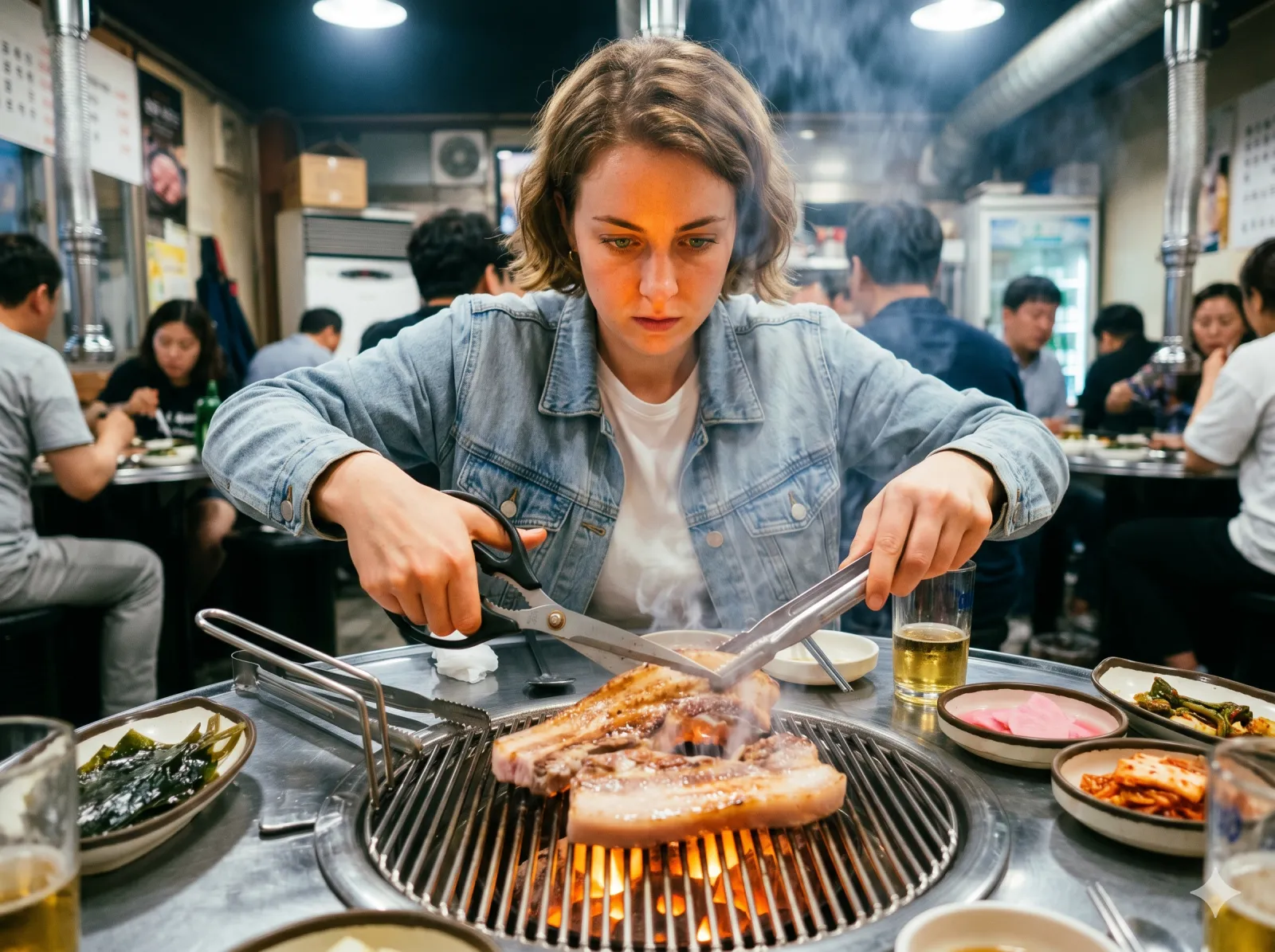
Scissors are a normal Korean BBQ tool for cutting grilled meat into bite-sized pieces.
Some restaurants hand you the tongs. Others do the grilling for you.
Charcoal-grill specialists and premium Korean BBQ restaurants often staff the table themselves. Elsewhere, a server sets the first pieces on the grill and steps back.
Don’t reach for the tongs the moment you sit down. Give it a beat and watch what the staff does first.
If someone starts cooking for you, let them work. If nobody comes over and the tables around you are grilling their own meat, that’s your signal to start.
For more on Korean grilling culture, samgyeopsal, and ssam, see the Korea Tourism Organization’s official Korean food guide.
Korean BBQ Etiquette: Tongs, Scissors, and the Call Button
Scissors are standard equipment at a Korean BBQ table, not an odd substitute for a knife.
Once the meat starts cooking, hold it with the tongs and snip it into bite-sized pieces right over the grill.
Don’t go looking for a steak knife — it won’t be there, and scissors handle thick pork better anyway.
Press the call button when you need something. It beats waving down a server across a full dining room.
A grill plate that’s heavily charred or sticking isn’t something to work around — ask staff to swap it out.
Pro Tip
Once pork fat starts pooling on the grill, push a little kimchi to the edge and let it cook in the fat — it comes out richer this way. If staff are running the grill for you, just follow their lead.
Korean BBQ Lettuce Wrap: How to Make Ssam
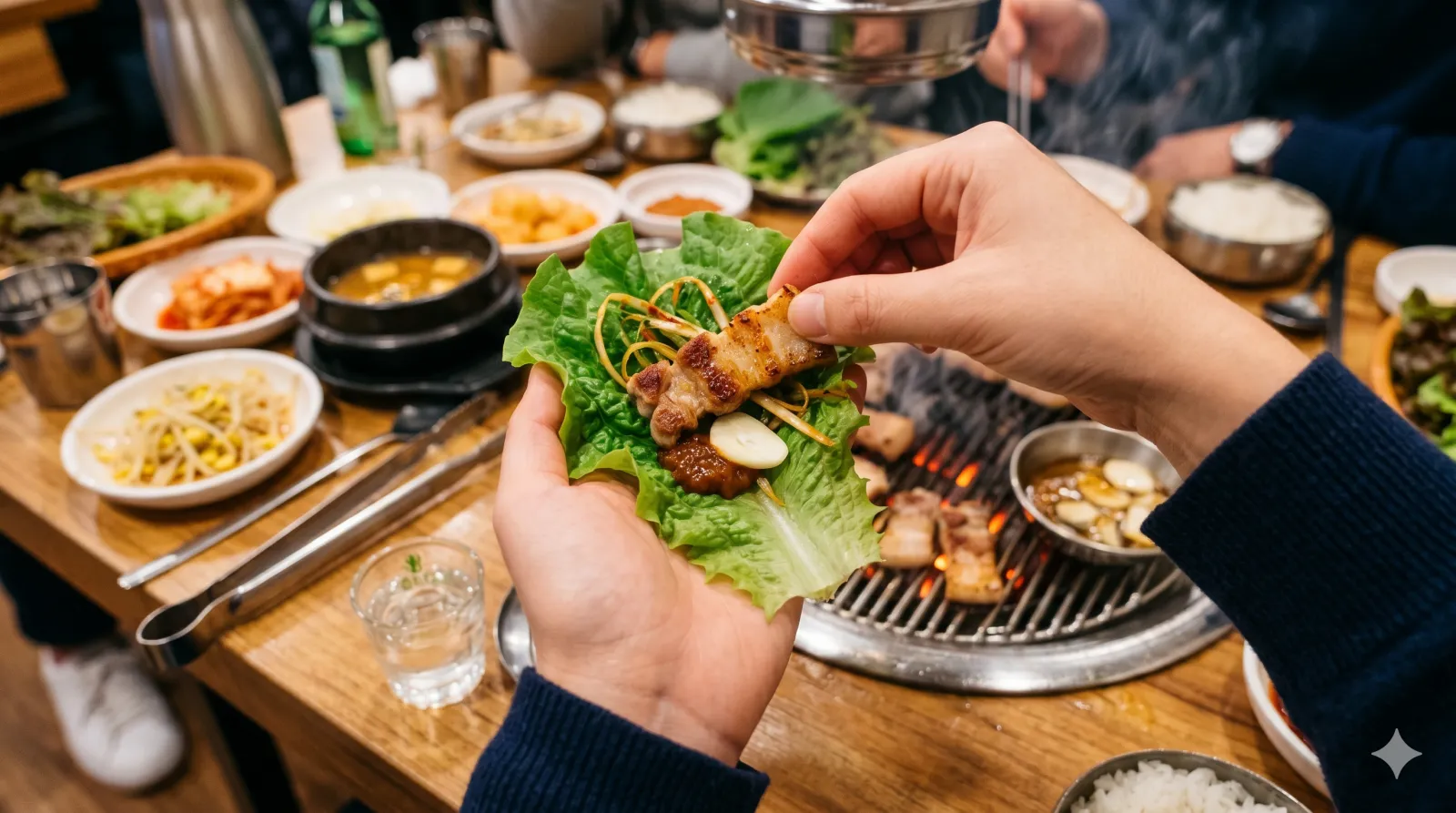
Ssam combines grilled meat with lettuce or perilla leaves, ssamjang, rice, garlic, and whatever else you enjoy.
Making ssam (쌈) — the Korean lettuce wrap — is half the fun of the meal.
Start with a lettuce or perilla leaf flat in your hand.
Add a little rice, one piece of grilled meat, a dab of ssamjang, and garlic or seasoned green onion if you want them.
Fold the leaf around the filling and eat it in one bite.
Skip whatever you don’t want — meat and ssamjang alone is a valid ssam, and a perilla leaf adds a stronger herbal note if that’s what you’re after.
The most common first-timer mistake is overloading the wrap. Go small until you get a feel for it.
Korean BBQ Side Dishes: What Is Banchan?

A Korean BBQ table often starts with kimchi, garlic, dipping sauces, vegetables, pickles, and other banchan before the meat reaches the grill.
The small dishes surrounding the grill are called banchan (반찬).
A typical spread includes kimchi, seasoned green onions, bean sprouts, garlic, lettuce, perilla leaves, pickled vegetables, and dipping sauces.
Steamed egg or soybean paste stew shows up at some tables as a free extra, at others as a line item.
Eat banchan whenever you want — between bites of meat, folded into a ssam, or alongside rice. There’s no set order.
Refills are common but not universal, and a few dishes come with a price tag. Ask before you assume seconds are free.
How Much Korean BBQ Should You Order Per Person?
Appetite, meat type, serving size, and side dishes all move the target number — there’s no fixed formula.
Two first-time diners tend to do better ordering light and adding a second round than overordering upfront.
Planning to add soybean paste stew, cold noodles, rice, or fried rice? Order less meat to start.
Korean BBQ orders in stages by design. Finish what’s on the grill, then decide if you want more.
Can You Eat Korean BBQ Alone in Seoul?
Yes — though not every traditional Korean BBQ restaurant is built with solo diners in mind.
Minimum meat orders and table setups at some places make a party of one impractical.
Skip the search for “one-person samgyeopsal” and look for restaurants advertising single-person set meals instead. Useful Korean search terms include:
돼지불백 정식 — grilled pork set meal
고기 정식 — meat set meal
혼밥 가능 — solo dining available
These sets typically bundle meat, rice, banchan, and soup for one diner.
Neighborhoods packed with students, office workers, and tourists tend to have more solo-friendly options. If the full tabletop-grill experience is the goal, check the restaurant’s minimum order before you sit down.
Somaek: The Soju and Beer Combination
Look around a Korean BBQ table and you’ll likely spot someone mixing soju and beer — that’s somaek (소맥).
The ratio comes down to personal taste, from a splash of soju to something considerably stronger.
Alcohol isn’t part of the deal. Water and soft drinks are just as normal an order.
Do You Tip at Korean BBQ in Korea?
Standard Korean restaurants skip American-style tipping entirely.
Pay what’s on the bill — a staff member grilling your meat table-side isn’t a reason to add more.
Some hotels and tourism-oriented services run differently, but at a standard Korean BBQ restaurant, no tip is the norm.
What to Know Before Eating Korean BBQ in Seoul
Seoul Korean BBQ spans casual neighborhood samgyeopsal restaurants, well-known tourist spots, and premium charcoal-grill restaurants where staff cook every piece of meat for you.
Before a first visit, check for an English menu. Restaurant listings on Visit Seoul note English-menu availability, prices, hours, and table-side grilling service for many locations.
For the popular spots, beat the dinner rush or check whether reservations are available — both save real time.
Frequently Asked Questions
What is the proper way to eat Korean barbecue?
Grill the meat until properly cooked, cut it into bite-sized pieces with scissors, and eat it on its own or wrap it in lettuce or perilla leaves with rice, ssamjang, garlic, and other toppings.
How do you order Korean BBQ for the first time?
Check the serving size and minimum order on the menu first. Many restaurants require more than one portion of meat per table. Start with samgyeopsal or moksal and add more meat later if needed.
Do you cook for yourself at Korean BBQ?
Some restaurants grill the meat for you; others expect guests to cook it themselves. Wait briefly after the meat arrives and follow the staff’s lead.
How much is Korean BBQ per person?
There is no single price. Cost depends on the restaurant, neighborhood, meat type, serving size, and additional dishes. Pork is usually more affordable than premium Korean beef.
What are Korean BBQ side dishes?
Korean BBQ side dishes are called banchan. Common examples include kimchi, seasoned green onions, bean sprouts, garlic, lettuce, perilla leaves, pickles, and dipping sauces. The selection varies by restaurant.
What is a Korean BBQ lettuce wrap?
A Korean BBQ lettuce wrap is called ssam. Place grilled meat on lettuce or a perilla leaf, add a little ssamjang and optional rice, garlic, or other toppings, then fold the leaf and eat it together.
Can I eat Korean BBQ alone in Seoul?
Yes, but some traditional Korean BBQ restaurants have minimum meat orders. Solo diners may find it easier to look for single-person grilled-meat set meals or restaurants marked as solo-dining friendly.
Do you tip at Korean BBQ in Korea?
Normally, no. Standard Korean restaurants don’t expect American-style tipping. Pay the amount shown on the bill unless a specific business states otherwise.
The first few minutes at a Korean BBQ table can feel unfamiliar. Once the meat starts sizzling and you fold your first ssam, it clicks.
You May Also Like
 Things to Do in Seoul: 15 Proven Picks Every First-Timer Needs
 Gwangjang Market Seoul: Street Food & Opening Hours
 Naver Maps English: 7 Tips to Navigate Korea Like a Local
 3 Korean Summer Foods: Bingsu, Naengmyeon & Samgyetang
 Free Seoul Metro Map & Tourist Maps: Official Downloads
 5 Best Areas to Stay in Seoul Near the Subway
 Seoul to Jeju: Flights, Travel Time & Airport Guide
 Seoul Subway Map & Transfer Guide: 7 Rules for Seoul Travel
 South Korea Travel Budget: One Month in Korea for $1,000
 Myeongdong Shopping Street & Night Market Guide