When I traveled overseas, I often carried a spare phone as well as my regular phone. I kept my usual SIM in my main phone so I could receive urgent calls through roaming. I put a local SIM in the spare phone for maps and internet access.
When I traveled with other people, I turned on the spare phone’s mobile hotspot and shared its data with the group. I also connected my laptop to the same hotspot. This saved us from buying a separate SIM for every person.
Roaming is simple for a short trip. However, a local SIM or Korea eSIM can cost less if you often use maps, transportation apps, messages, or social media. Free Wi-Fi is available on some Seoul buses and subway trains, but it is not always reliable while you are moving.
Seoul travel begins as soon as you arrive at Incheon Airport. Before leaving the terminal, you may need the internet to find your hotel, check the AREX train, call a taxi, or translate Korean signs.
This guide compares tourist eSIM prices from SK Telecom, KT, and LG U+. It also explains the difference between an eSIM and a physical SIM card and where late-night arrivals can buy or collect a SIM at Incheon Airport.

Why You Need Mobile Data After Arriving in Korea
Incheon Airport offers free Wi-Fi, but that connection does not follow you into Seoul. Mobile data is useful immediately for:
- Finding your hotel and subway route with Naver Map
- Calling a taxi through Kakao T
- Checking AREX trains and airport buses
- Translating signs and menus with Papago or Google Translate
- Opening hotel confirmations and mobile vouchers
- Sending your arrival time to your family or accommodation
If you have an unlocked phone that supports eSIM, you can prepare a Korea eSIM before departure. If your phone does not support eSIM or you want help with setup, you can buy a physical SIM card at Incheon Airport.
Korea eSIM vs International Roaming
International roaming lets you keep your regular phone number and carrier. It is a simple choice for a short business trip or very light data use.
A Korea eSIM or local SIM card can offer better value when you regularly use maps, videos, messaging, or social media. Korean carriers sell tourist plans for different trip lengths.
Before buying, check:
- Whether your phone supports eSIM
- Whether your phone is carrier-unlocked
- Whether outgoing calls and texts require a separate balance
- Whether the plan activates online or requires airport pickup
- When the plan’s validity period begins
Korea eSIM Prices: SK Telecom vs KT vs LG U+
The table below shows representative LTE tourist-plan prices listed on the official English websites of Korea’s major carriers.
| Plan length | SK Telecom | KT | LG U+ |
|---|---|---|---|
| 1 day | ₩6,500 (about US$4.60) | ₩6,500 (about US$4.60) | ₩6,500 (about US$4.60) |
| 3 days | ₩18,000 (about US$12.90) | ₩18,000 (about US$12.90) | ₩18,000 (about US$12.90) |
| 5 days | ₩27,500 (about US$19.60) | ₩27,500 (about US$19.60) | ₩27,500 (about US$19.60) |
| 7 days | ₩35,000 (about US$25) | ₩35,000 (about US$25) | ₩35,000 (about US$25) |
| 10 days | ₩38,500 (about US$27.50) | ₩38,500 (about US$27.50) | ₩38,500 (about US$27.50) |
Exchange rate used: US dollar prices were calculated at approximately ₩1,400 per US$1. They are provided as a guide. The final amount can vary with the exchange rate on the payment date and card fees.
The three carriers list the same prices for the representative 1-, 3-, 5-, 7-, and 10-day plans above. Prices for other plan lengths can differ.
Online reservations and airport purchases can have different prices or benefits. Buying at the airport is not always more expensive. Compare each carrier’s official online offer with the current airport-counter offer.
Prices and benefits can change. Check the latest details on the official SK Telecom, KT, and LG U+ websites before buying.
Which Carrier Should You Choose?
SK Telecom, KT, and LG U+ are major Korean mobile carriers. Their representative tourist-plan prices are almost the same, so compare the features and traveler benefits instead of price alone.
- SK Telecom: Some tourist products include transportation-card and royal-palace benefits.
- KT: Tourist products are available through different purchase and pickup methods.
- LG U+: Some airport-pickup products include a transportation-card benefit.
A free transportation card does not mean free rides. The card itself may be free, but you must add money to pay bus and subway fares.
eSIM vs Physical SIM Card

When an eSIM Is More Convenient
An eSIM is a digital SIM built into your phone. You install it by scanning a QR code, so you do not need to remove your regular SIM card.
- You want to avoid waiting at an airport counter.
- You want to prepare your data before departure.
- You want to keep your regular SIM while adding Korean data.
- You do not want to handle or store a small SIM card.
Your phone must support eSIM and be carrier-unlocked. Some eSIM products cannot be installed again after deletion, so read the provider’s instructions before scanning the QR code.
If your phone supports dual SIM, you can keep your US number for incoming calls and use a Korea eSIM for data. Your US carrier can still charge international roaming fees when you receive a call.
When a Physical SIM Card Is More Convenient
A physical SIM is the small removable card inserted into a phone. It is useful when:
- Your phone does not support eSIM.
- You want airport staff to help with setup.
- You prefer a removable SIM card.
- You want a Korean phone number.
A Korean tourist SIM gives you a Korean phone number beginning with 010. Internet data is included in the plan price. Depending on the product, outgoing calls and texts require a separate prepaid balance.
If you remove your US SIM and replace it with a Korean SIM, you cannot receive regular calls or texts sent to your US number on that phone.
If you must receive calls on your US number, keep the US SIM in your regular phone and use roaming for incoming calls. Put the Korean SIM in a spare phone for maps and internet access.
When several people travel together, one person can put a Korean SIM in a spare phone and share the data through a mobile hotspot. A laptop can also connect to the same hotspot, so every traveler does not need to buy a separate SIM.
Keep any removed SIM card in a safe place during the trip.
Can You Buy an eSIM or SIM Card at Incheon Airport?
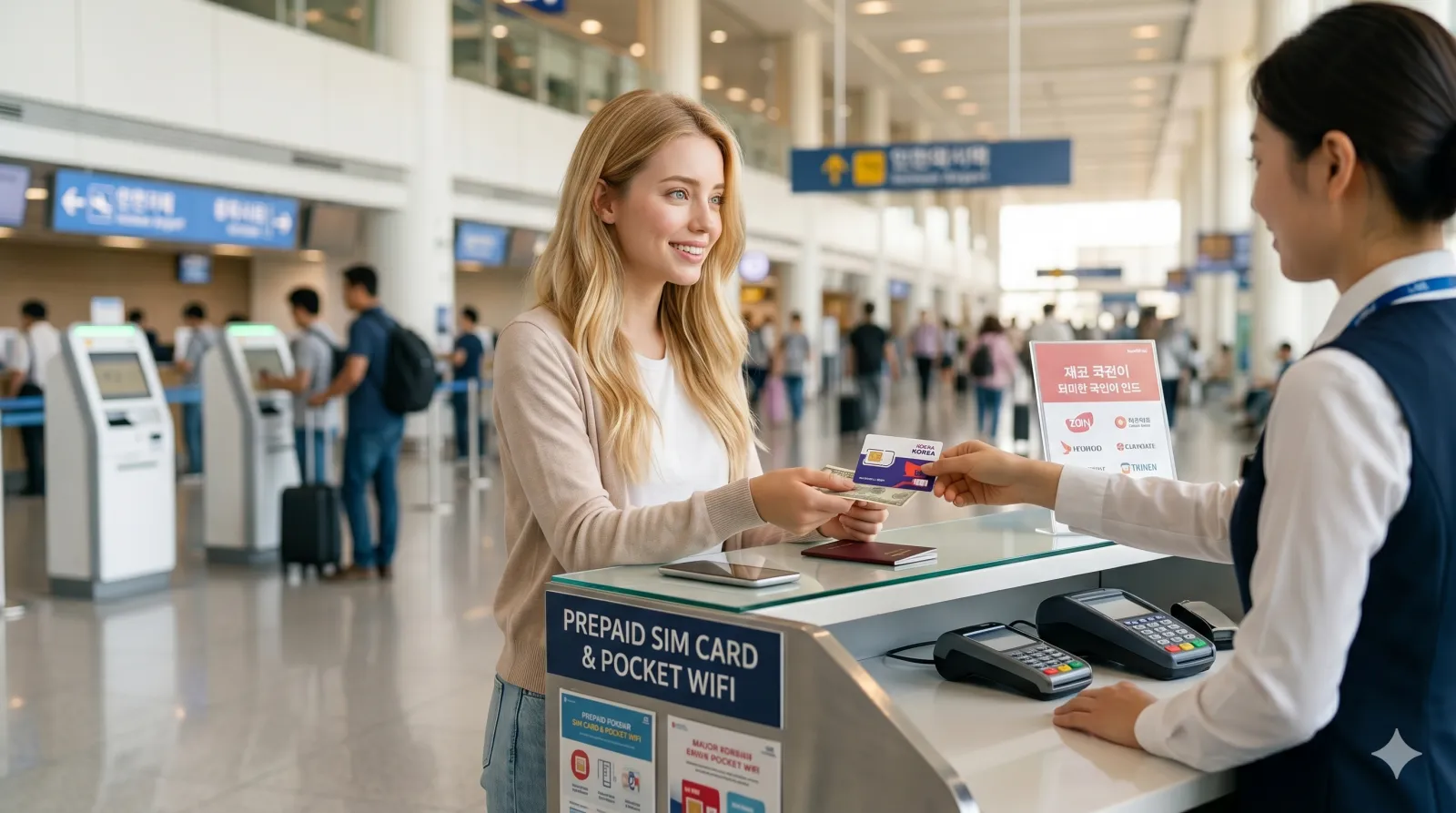
Incheon Airport Terminals 1 and 2 have SK Telecom, KT, and LG U+ roaming centers. Depending on the product and counter, you can:
- Buy a tourist SIM at the airport
- Collect a product reserved online
- Ask for installation and activation help
- Check whether the product works with your phone
Passport verification is required for tourist SIM activation, so bring your passport to the airport counter.
The official Incheon Airport directory lists 24-hour SK Telecom, KT, and LG U+ roaming centers near Arrival Hall F on the west side of the first floor of Terminal 1.
Other counters operated by the same carriers have different hours. A 24-hour counter does not mean every carrier counter in Terminals 1 and 2 stays open all night.
If you arrive late, use the official Incheon Airport telecommunications directory to find the correct counter for your terminal and reserved product.
How to Prepare Your eSIM Before Flying
Some carriers advise dialing *#06# and checking whether an EID appears. An EID means your phone is designed to support eSIM, but compatibility also depends on the phone model, country of purchase, and carrier settings. Check the provider’s supported-device information as well.
- Confirm that your phone supports eSIM.
- Make sure the phone is carrier-unlocked.
- Buy a Korea eSIM plan for your trip length.
- Connect to stable Wi-Fi.
- Scan the QR code sent by email.
- After arriving in Korea, select the eSIM as your mobile-data line.
- Follow the provider’s instructions for the data-roaming setting.
Installation and validity rules differ by carrier. Check when the usage period starts before installing or activating your eSIM.
Checklist Before Leaving Incheon Airport
- Test that Korean mobile data is working.
- Turn off data roaming on your regular SIM if needed.
- Search for your hotel in Naver Map.
- Save your hotel confirmation for offline access.
- Choose the AREX, an airport bus, or a taxi.
- Save your hotel address in both English and Korean.
- Check the battery levels of your phone and power bank.
Final Recommendation
International roaming is simple for a short trip with very little data use. A Korea eSIM or local SIM can offer better value when you often use maps, translation, messaging, and social media.
If you must receive calls on your regular number, use dual SIM or keep your regular SIM in your main phone and put a Korean SIM in a spare phone. The spare phone can also share data with your travel group and laptop through a mobile hotspot.
The representative tourist-plan prices from SK Telecom, KT, and LG U+ are almost the same. Choose based on phone compatibility, outgoing call and text costs, airport pickup location, and included benefits.
You May Also Like
 Apartment in Seoul: 5 Best Options for Foreigners
 Seoul to Jeju: Flights, Travel Time & Airport Guide
 South Korea Travel Budget: One Month in Korea for $1,000
 Korea Convenience Store Guide: CU, GS25 & Tourist Tips
 Everything You Need to Know About Han River Seoul: Parks, Ramen & Night Views
 T-Money Card vs WOWPASS: Which Is Better for Seoul Travel?
 Naver Maps English: 7 Tips to Navigate Korea Like a Local
 How to Eat Korean BBQ in Seoul
 5 Best Areas to Stay in Seoul Near the Subway
 Seoul Subway Map & Transfer Guide: 7 Rules for Seoul Travel